Training pace calculator
Enter a recent race result and get your training paces by zone (easy, marathon, threshold, interval and repetition), based on Jack Daniels’ method.
Paces based on Jack Daniels’ VDOT method. They’re a training reference, not a rigid rule: adjust them to how you feel, the terrain and the weather. Interval and repetition paces are run on a track or as short reps, which is why their splits are included.
Training Pace Calculator
Enter a recent race result and get your training paces by zone (easy, marathon, threshold, interval, and repetition), based on Jack Daniels’ method.
Paces based on Jack Daniels’ VDOT method. They’re a training reference, not a rigid rule: adjust them to how you feel, the terrain, and the weather. Interval and repetition paces are run on a track or as short reps, which is why their splits are included.

What is the training pace calculator
The training pace calculator is the tool that translates your current fitness level into the exact paces at which you should run each type of session. Instead of training “by feel” or copying another runner’s paces, you enter a recent race result and instantly get the pace per kilometer at which you should run easy, hold your tempo runs, or push in your reps.
It’s based on the VDOT method developed by coach and physiologist Jack Daniels, one of the most well-established systems in the running world. From your race result, the training pace calculator estimates your VDOT (a value equivalent to your VO2max adjusted for running) and from there derives five clearly defined pace zones. Along with race pace, it’s one of the most consulted calculators among those who take their progression seriously.
How to use this training pace calculator
It works instantly. Choose the distance of a recent race you ran all out (5K, 10K, half marathon, or marathon), enter your time, and hit calculate. The training pace calculator will show you your estimated VDOT and the pace per kilometer for each of the five zones, plus the track splits for interval and repetition sessions.
For reliable results, use a recent result run at full effort: if you enter a time from two years ago or from a race you ran without pushing, the paces will be out of sync with your current fitness.
Why train by paces and not at random
The most common mistake among recreational runners is running almost always at the same pace: neither easy enough to build an aerobic base, nor fast enough to generate quality adaptations. It’s the well-known “gray zone.” Training by paces solves exactly that: each session has a purpose and a target pace that respects it.
Daniels showed that the bulk of volume should be run slowly. His reference recommendation is that between 70 and 80% of weekly mileage should be done at easy pace, and only the remaining 20-30% at quality paces (marathon, threshold, interval, and repetition). Respecting that split is what prevents overtraining and makes hard sessions truly pay off. A well-used training pace calculator isn’t only for going fast: above all, it’s for knowing when to go slow.
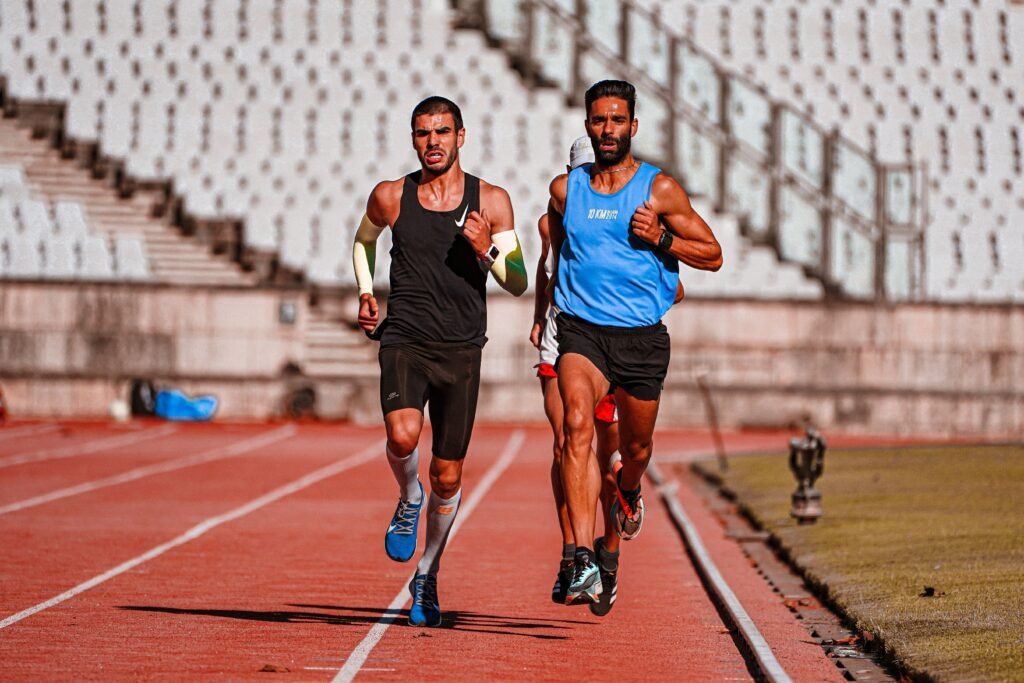

The VDOT Method: The Science of Jack Daniels
The VDOT system is a metric that represents a runner’s maximal oxygen uptake (VO2max), but adjusted for their running economy and real competitive performance capacity. Unlike laboratory VO2max, VDOT is derived from race times, which makes it extremely practical for training planning.
What is VDOT?
VDOT is a measure of current running capacity. When you enter a recent or estimated race result, the system generates a VDOT score and the corresponding training paces. The main goal of training according to VDOT is to obtain the maximum physiological benefit while minimizing the effort required, which promotes healthy, responsible sessions while preventing overtraining.
Daniels’ Training Phases
The method contemplates four fundamental phases for preparing an athlete:
- Phase 1 – General Preparation: Focus on the aerobic base through Easy (E) and Marathon (M) paces.
- Phase 2 – Strength and Speed: Introduction of Threshold (T) paces and Intervals (I), along with gym work and hills.
- Phase 3 – Specific Preparation: Preparation for long distances, reaching peak weekly mileage.
- Phase 4 – Tapering: Reduction of volume to arrive rested at the competition, while maintaining quality paces.
The Paces the Training Pace Calculator Gives You
Knowpace’s calculator breaks training down into five main zones, each with a distinct physiological goal:
1. Easy Pace (E)
- Intensity: Generally between 59-74% of VO2max or 65-79% of Maximum Heart Rate (MHR).
- Purpose: Build a solid base. Easy pace strengthens the heart muscle, increases blood supply to the muscles, and improves the ability to process oxygen. It’s essential for recovery runs and long runs.
- Feel: It should be conversational. Daniels suggests you can vary the pace by up to 20 seconds per mile depending on how you feel that day or the terrain.
2. Marathon Pace (M)
- Intensity: Between 75-84% of VO2max or 80-90% of MHR.
- Purpose: Experience race-pace conditions for marathoners, or serve as a more intense alternative to easy pace for beginners.
- Use: Commonly used in long runs or specific blocks within a run.
3. Threshold Pace (T)
- Intensity: Approximately 83-88% of VO2max or 88-92% of MHR.
- Purpose: Improve lactic endurance. It’s the pace you can hold “comfortably hard” for 20 to 40 minutes.
- Format: Can be done as continuous runs (Tempo) or cruise intervals with short recoveries.
4. Interval Pace (I)
- Intensity: Between 95-100% of VO2max or 98-100% of MHR.
- Purpose: Stress aerobic power (VO2max). Repetitions of 3 to 5 minutes are performed to maximize the time spent at 100% of aerobic capacity.
- Note: Exceeding 5 minutes per rep is not recommended, to avoid excessive lactate accumulation that undermines the aerobic goal.
5. Repetition Pace (R)
Key: Technique must be flawless. If the runner can’t run relaxed, the recovery is insufficient.
Purpose: Improve speed and running economy. These are fast efforts but not necessarily “exhausting” in terms of lactic fatigue, since they include full recoveries.
Introduction and Value of Structured Training
Modern endurance training isn’t simply about “running more,” but about running with a purpose. According to scientific consensus, success in distance running depends on optimizing different metabolic systems. The training pace calculator allows runners to identify their exact pace zones from a recent race result, ensuring that every kilometer contributes to a specific physiological adaptation.
This training pace calculator is an integral part of Knowpace’s running tools ecosystem, which ranges from race predictors to VO2max estimators.
- ⏱️ Pace calculator: To calculate basic times and splits.
- 🎯 Race predictor: Estimate your times across different distances.
- ❤️ Heart rate zones: Complement your paces with heart-rate monitoring.
- 🔄 Pace converter: Easily switch between min/km and km/h.
- 📈 VO2max estimator: Discover your aerobic potential.
- 🍌 Carbs during running: Plan your nutrition for long sessions.
Nutrition and Carbohydrates in Performance
I want to stress that optimizing your training paces should go hand in hand with a solid nutritional strategy to get the most out of your performance. Research led by experts such as Asker Jeukendrup underlines the importance of carbohydrates during endurance exercise, as they will be our primary energy source.
Carbohydrate Intake by Duration
Below I’ve added some reference figures suggesting a personalized intake based on session duration which, combined with the results from the training pace calculator, will let you get optimal performance out of your workouts:
- 45-75 minute sessions: Only a small amount of carbohydrates is needed, or even just a carbohydrate mouth rinse to improve performance.
- 1-2 hour sessions: An intake of 30 g/h is recommended.
- 2-3 hour sessions: Increasing to 60 g/h is recommended.
- Sessions over 2.5 hours: Up to 90 g/h can be consumed (or even 120 g/h in trained athletes), using multiple-transportable carbohydrate mixes (glucose and fructose).
Training the Digestive System
You shouldn’t rely solely on the numbers from the training pace calculator and hourly carbohydrate intake during training sessions, since it’s essential to “train the gut” to tolerate high amounts of carbohydrates during exercise. This includes practicing intake during sessions at Marathon (M) or Threshold (T) pace as returned by our training pace calculator. Knowpace offers a specific carbs-during-running calculator to plan these intakes.

ACSM Guidelines for Endurance Athletes
That said, I’d like to emphasize that consistency is very important, and that’s why I want to reference the American College of Sports Medicine (ACSM), which sets the “gold standards” for exercise recommendations. According to their most recent guidelines, they recommend:
- Aerobic Activity: All healthy adults aged 18 to 65 should perform at least 30 minutes of moderate-intensity aerobic physical activity five days a week, or 20 minutes of vigorous intensity three days a week.
- Strength Training: It’s recommended to perform activities that maintain or increase muscular strength and endurance at least two days a week.
- Benefits: Regular physical activity regulates blood pressure, helps manage anxiety and depression, and prevents uncontrolled weight gain.
For the runner using a training pace calculator, following these guidelines ensures overall health that supports athletic performance.
Frequently Asked Questions
Which race result should I enter in the training pace calculator?
The most recent one you’ve run at maximum effort. A recent 5K or 10K is usually the most practical and reliable reference for most recreational runners.
How often should I recalculate my training paces?
Every time you improve a personal best or every 6-8 weeks of consistent training. As you get fitter, your VDOT rises and your target paces get faster, so it’s worth updating them.
Does the training pace calculator work for any level of runner?
Yes. Whether you’re aiming to finish your first 10K or preparing a sub-three-hour marathon, the method adjusts the paces to your actual level. What matters is entering an honest result and respecting the split between easy running and quality work.
Are the paces an exact rule?
They’re a very solid reference, but not a mandate. Heat, wind, accumulated fatigue, or elevation gain all justify adjusting the pace. Listen to your body too: the training pace calculator guides you, your sensations fine-tune it.
Why does my easy pace feel “too slow”?
It’s a common concern. Easy pace (E) is designed to build aerobic capacity without excessive fatigue. Running faster than indicated in this zone often leads to the “gray zone,” where the effort is too high to recover from and too low to generate quality adaptations.
How do I adjust the paces for weather?
VDOT paces are references for standard conditions. In extreme heat, high humidity, or strong wind, you need to adjust the paces upward (run slower) to maintain the desired physiological intensity (MHR).
Recommended External Links
- V.O2 Running Calculator: The official source for Jack Daniels’ methodology.
- ACSM Physical Activity Guidelines: Official physical activity guidelines from the American College of Sports Medicine.
- PMC – Nutrition and Athletic Performance: Scientific article on carbohydrate intake and personalized sports nutrition.
Conclusions
Training by paces turns every outing into a session with a purpose. Instead of always running at the same pace and getting stuck in the “gray zone,” Jack Daniels’ VDOT method lets you assign each workout the exact intensity that targets a specific adaptation: aerobic base with easy pace, endurance with marathon pace, lactate tolerance with threshold, aerobic power with intervals, and speed with repetitions.
The key, however, isn’t running fast, but respecting the split: most of your volume should be easy running, reserving quality sessions for specific moments. That balance is what produces sustained improvements and prevents overtraining and injuries.
Use this training pace calculator as your starting point: enter a recent race result, note down your five zones, and update them every time you progress. Combine it with a good nutrition strategy and the rest of KnowPace’s tools for a complete view of your preparation. The numbers guide you; your sensations, consistency, and rest do the rest.