NIKE VAPORFLY 4
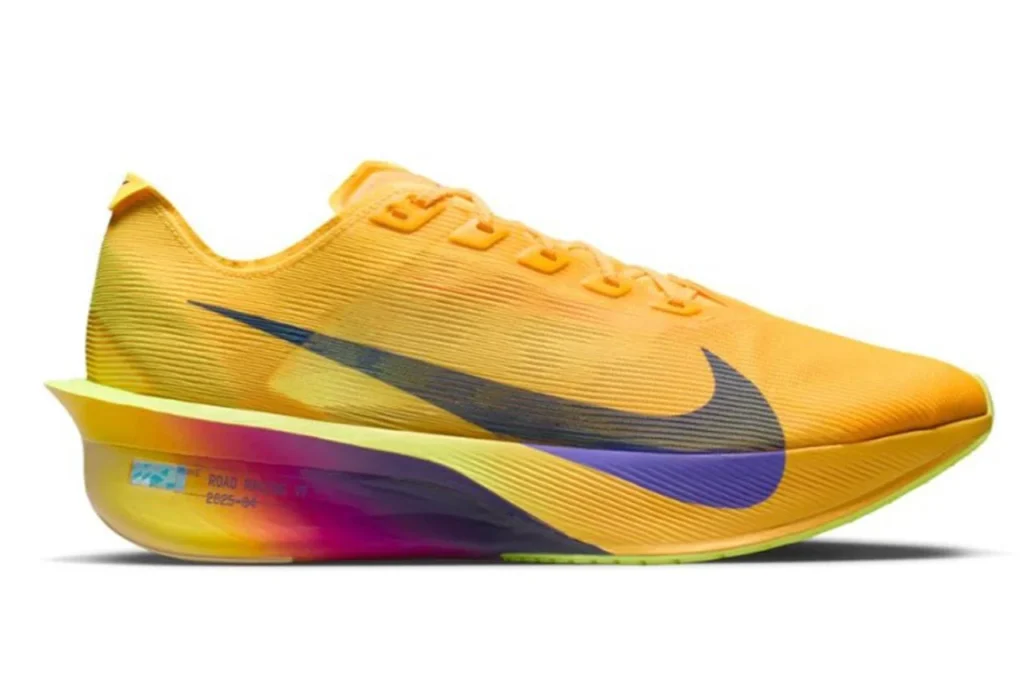
| Type | Road |
| Weight | 190 g |
| Drop | 6 mm |
| Foot strike | Neutral |
| Recommended use | Mixed |
| Carbon plate | Yes |
Nike Vaporfly 4: Full Review of the Fastest Racing Shoe
The Nike Vaporfly 4 arrives to redefine, once again, what we expect from a racing shoe. If the previous versions had flirted with marathon versatility, this fourth release takes a clear turn: it goes back to pure speed roots, lighter, lower and more aggressive. In this Nike Vaporfly 4 review we take a thorough look at its updates, its technical data, how it behaves on the run and, above all, which runner it makes sense for and which it does not.
Here is the verdict for those in a hurry: it is a precision tool built to break personal bests over short and medium distances, from 5K to the half marathon, at the cost of some heel stability. Below you have the full analysis, with its highs and lows.
What’s New: Back to Racing Roots
The Vaporfly line changed the rules of world athletics, but each version has sought its own balance. The third release leaned toward more cushioning and marathon versatility; the Nike Vaporfly 4 corrects course and bets again on lightness and immediate response.
The most striking change is in the profile. Nike has reduced the midsole height (stack height) from 40 to 35 millimeters, a bold decision in a market saturated with super-shoes at maximum profiles. Less foam under the foot means less weight and a feel closer to the ground, more direct. Alongside that change, the drop drops from 8 to 6 millimeters, aiming for a more natural transition for midfoot or forefoot runners.
The result is a shoe that feels like an heir to the first racing models: it prioritizes agility and bounce over bulky cushioning. The Vaporfly 4 is, in essence, a statement of intent in favor of speed.
Technical Specifications
Before getting into feel, it helps to be clear about the numbers that define this shoe. These are the official figures and those obtained in testing:
| Feature | Detail |
|---|---|
| Weight | ~190 g (men’s size 44) |
| Drop | 6 mm |
| Profile (stack height) | 35 mm |
| Midsole | Nike ZoomX foam |
| Plate | Full-length Flyplate carbon fiber |
| Upper | Engineered mesh |
| Use | Road racing (mile to marathon) |
| Price | 259.99 € |
Weight is around 190 grams in a men’s size 44, placing it among the lightest in its category. The drop is 6 millimeters and the profile or stack height sits at 35 millimeters, reduced from the 40 of the previous generation. The midsole mounts full Nike ZoomX foam, with a full-length Flyplate carbon fiber plate inside. The upper is engineered mesh. Nike recommends it for road racing, from the mile to the marathon, with a launch price of 259.99 euros.
Of all these figures, the drop adjustment and the profile reduction are the ones that most change the shoe’s character compared to its predecessor, pushing it toward a more specific fast-racing use.
The Upper: From Flyknit to Engineered Mesh
One of the most celebrated changes is swapping the Flyknit fabric for an engineered mesh. Although Flyknit offered that characteristic sock-like fit, the new mesh brings clear advantages for racing.
Breathability improves noticeably: the mesh design allows constant airflow that keeps the foot cooler during intense efforts, something you appreciate in fast races. In addition, the mesh structure is lighter than the previous fabric, contributing to those 190 total grams.
The lockdown has also been revised. The eyelet and lacing system was redesigned to achieve a more secure foot lockdown, eliminating internal movement during turns or pace changes. The overall sensation is a comfort you barely notice, which is exactly what you want in a racing shoe: for it to disappear under your foot and let you run.
Midsole and Responsiveness: ZoomX and the Flyplate
The heart of the Vaporfly 4 remains the combination of ZoomX foam and the Flyplate carbon plate, but with a refined implementation to squeeze out energy return.
ZoomX foam is, according to Nike, the most reactive in its catalog. Despite the volume reduction to save weight, it keeps notable elasticity from heel to toe. It is responsible for that bounce feel that characterizes the line.
The Flyplate has been repositioned at a greater angle. This biomechanical change aims to increase the sensation of forward propulsion in every stride, and is one of the reasons the shoe encourages you to run fast. Finally, the heel design lets the midsole protrude slightly at the back: it is not just an aesthetic detail, but optimizes stride stability and allows internal material to be hollowed out to cut weight without compromising the structure.
Outsole and Traction
On the outsole, Nike has listened to elite runners and returned to a single-piece rubber design for the forefoot, recovering the configuration of the first and most successful Vaporfly.
This solution offers excellent traction on both dry and wet road, letting the force the runner generates transfer to the ground without losses from slipping. The simplified outsole is also another key piece in the shoe’s weight saving. It is an example that sometimes going back to what worked is the best evolution. It also reflects a wider trend among racing shoes: after years of adding material and complexity, brands are learning that shaving grams and simplifying construction often serves the competitive runner better than piling on features. The Vaporfly 4 embodies that lesson, trimming everything that does not directly contribute to speed.
On-the-Run Feel: Pure Speed
The experience of running in the Vaporfly 4 boils down to one word: speed. It is a shoe that, according to testers, practically begs you to push the pace, according to specialist tester analysis.
Where it truly shines is at paces of 4:30 per kilometer or faster. At those speeds, the combination of lightness and carbon plate generates an agility and bounce that make sustaining the effort easier, improving running economy. It is the terrain it was designed for, and there it feels like a missile over 5K, 10K and the half marathon.
The other side appears in the marathon and at slow paces. Although the manufacturer certifies it from the mile to the marathon, for slower runners or those who land hard on the heel, the shoe can feel unstable, especially in the final kilometers when fatigue compromises technique. The softness of the foam at the rear, combined with the lower profile, makes heel stability lower than in a model like the Alphafly. If you want to perform over 5K or the half marathon, calculating your target paces in advance will help you squeeze out its full potential.
Comparison with Its Rivals
To place the Vaporfly 4 in the current market, it helps to pit it against its most direct alternatives.
Against the Vaporfly 3, the new version is lighter, with less drop (6 versus 8 millimeters) and a lower profile (35 versus 40). That makes it less comfortable for slow paces, but more reactive for pure racing. It is a change of philosophy, not a simple update.
Against the Nike Alphafly, the Alphafly remains the queen of cushioning and stability for the marathon, while the Vaporfly 4 positions itself as the nimbler, more aggressive option for shorter distances. They are sisters with different callings.
Against the competition, the Adidas Adizero Pro 4 presents itself as a more stable alternative for long distances, which you can pit against this one in our shoe comparison, and the ASICS MetaSpeed Sky offers similar lightness but with a slightly more forgiving ride. The Vaporfly 4, by contrast, is more aggressive and less forgiving of poor technique: it rewards those who run well and punishes mistakes.
Pros and Cons: Who Is It For?
With the whole analysis on the table, it helps to summarize its strong and weak points so you can see at a glance whether it fits you.
Among the advantages, its extreme lightness stands out, with 190 grams placing it among the lightest in its category. Propulsion is superior thanks to the new Flyplate angle, which offers a powerful toe-off on every stride. The engineered mesh upper is a step forward in comfort and ventilation. And its aggressive design makes it an ideal candidate for breaking personal bests over short and medium distances.
Among the drawbacks, the main one is the lower heel stability, which can be a problem for heel strikers or for those accumulating fatigue over long distances. The durability of ZoomX foam is another point to watch: being a high-performance, low-density material, it can show signs of wear after few kilometers of intensive use. And the price, at 259.99 euros at launch, remains a high investment for such a specific-use shoe, though you can watch for running deals to get it cheaper.
Final Verdict
The Vaporfly 4 is a pure racing shoe, and it owns that without complexes. It does not try to be a training shoe or a comfortable option for jogging: it is a precision tool designed for speed.
If you are a runner with good technique chasing your best time over 5K, 10K or the half marathon, and you value lightness and immediate response above all, it is one of the best running shoes on the market in 2026. On the other hand, if you want a more stable shoe to complete your first marathon at moderate paces, within Nike’s own range the Alphafly or the Zoomfly 6 will fit better.
In short, the Vaporfly 4 is a bold evolution that recovers the essence of the fastest racing shoes in the world, sacrificing some protection in exchange for a tangible gain in agility and propulsion. For its target audience, the runner who wants to fly, it delivers with flying colors.
Frequently Asked Questions
What distances is the Nike Vaporfly 4 best for?
It shines especially over short and medium distances: 5K, 10K and the half marathon. Its light, aggressive character makes it a missile at paces of 4:30 per kilometer or faster. Although the manufacturer certifies it up to the marathon, at that distance and at slow paces it loses some stability, making it a riskier choice for slower runners or heel strikers in very long events.
How much does the Vaporfly 4 weigh and what drop does it have?
It weighs around 190 grams in a men’s size 44, placing it among the lightest racing shoes. The drop is 6 millimeters, reduced from the 8 of the Vaporfly 3, and the profile or stack height drops to 35 millimeters from the previous 40. These changes aim for a more natural, direct footstrike oriented toward speed.
What are the differences between the Vaporfly 4 and the Vaporfly 3?
The Vaporfly 4 is lighter, with less drop (6 versus 8 millimeters) and a lower profile (35 versus 40). It also debuts an engineered mesh upper instead of Flyknit and a Flyplate with a greater propulsion angle. Overall, it is less comfortable for slow paces but more reactive and aggressive for pure racing, a change of philosophy more than a simple update.
Is the Nike Vaporfly 4 worth it for a marathon?
It depends on your profile. For fast runners with good midfoot or forefoot technique it can work in a marathon, but for slower runners or heel strikers the lower heel stability shows in the final kilometers, when fatigue affects technique. If your goal is the marathon and you want maximum stability, the Nike Alphafly is a more suitable alternative within the same brand.
Is the ZoomX foam in the Vaporfly 4 durable?
ZoomX foam is high-performance and low-density, which makes it very reactive but also prone to showing wear after intensive use. As with all racing super-shoes, it is best to reserve it for races and quality sessions rather than using it as a daily training shoe, to extend its lifespan and keep its performance for as long as possible.
How much does the Nike Vaporfly 4 cost?
Its launch price is 259.99 euros, in line with high-end racing super-shoes. It is a high investment for a specific-use shoe, so it makes more sense as a racing complement alongside a good training shoe than as your only footwear. Taking advantage of deals or the launch of the next version can be a way to get it cheaper.
Want to get the most out of it? Pair the Nike Vaporfly 4 with well-calibrated training: calculate your target paces, control intensity with our Heart Rate Zone Calculator and reach the start line ready to fly.