VO2 Max: What It Is, Normal Values, How to Measure and Improve It
VO2 max is probably the most famous number in sports physiology, and ever since GPS watches started estimating it every day, many runners look at it as if it were their grade. It is a useful measure of aerobic capacity, but it doesn’t explain everything: two runners with the same value can have very different race times. In this guide I explain what VO2 max is, what values are normal, how to measure or estimate it, how much it matters for your performance and how to improve it.
What VO2 max is
VO2 max, or maximal oxygen uptake, is the maximum amount of oxygen your body can take in, transport and use per minute during hard effort. It is expressed in milliliters of oxygen per kilo of body weight per minute (ml/kg/min).
It depends on three things: how much blood your heart pumps with each beat, how much oxygen that blood carries and how much of that oxygen your muscles can use. That is why it improves with aerobic training, which enlarges the heart and increases mitochondria. I explain the latter in the guide on how to train in zone 2.
Normal VO2 max values
It varies a lot with age, sex, genetics and training. As a rough reference:
| Profile | Approximate VO2 max (ml/kg/min) |
|---|---|
| Sedentary person | 30 to 40 in men, 25 to 35 in women |
| Recreational runner | 45 to 55 in men, 40 to 50 in women |
| Advanced recreational runner | 55 to 65 in men, 50 to 58 in women |
| Elite distance runner | 70 to 85 in men, 60 to 75 in women |
It naturally drops with age, but people who train regularly keep it much better than those who don’t.
How to measure your VO2 max
In a lab
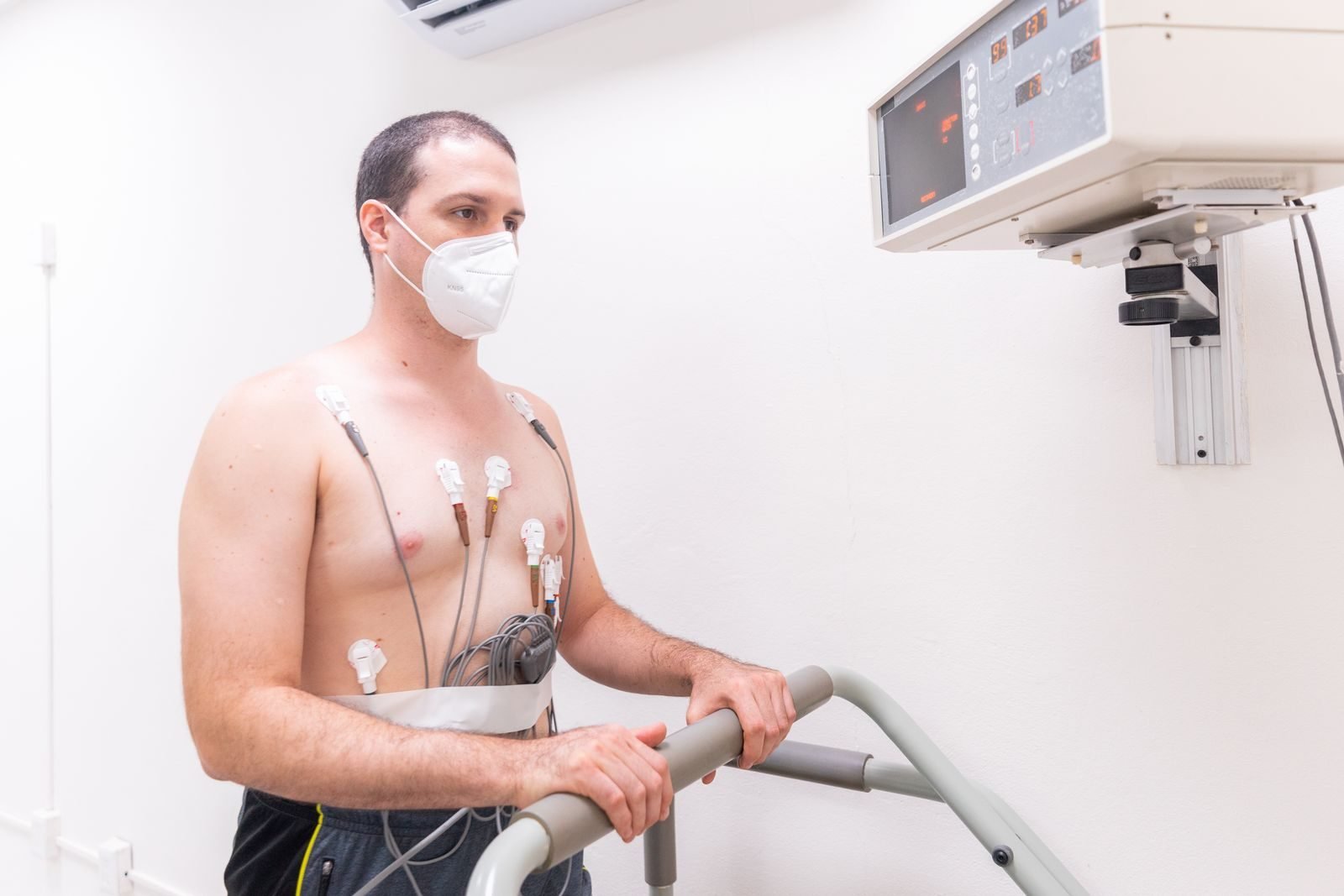
The precise way is an exercise test with gas analysis: you run on a treadmill wearing a mask while the pace increases until exhaustion. It is done at sports medicine centers and, besides that value, it gives you your real thresholds and zones.
With a field test
The best known is the Cooper test: you run as far as you can in 12 minutes and, from the distance, estimate your VO2 max with the formula (meters − 504.9) / 44.73. If you cover 2,800 meters, you get a VO2 max of about 51.
From a race
Your time in a 5K or 10K lets you estimate it quite accurately, because it reflects what your body can do in competition. That is what our VO2 max calculator does: you enter your time and it gives you an estimate.
With your watch
Many watches estimate it by combining your pace with your heart rate. They are useful for spotting trends, whether it goes up or down over time, but the exact number can be quite far off, especially if your heart rate isn’t measured well.
How much VO2 max matters for running
It is an important piece, but not the only one. Your race performance depends on three things: VO2 max, the percentage of it you can sustain for a long time (your threshold) and your running economy, meaning how much energy you use at a given pace.
That is why a runner at 55 ml/kg/min with good threshold and economy can beat one with 60. Beyond a certain level of training, maximal oxygen uptake improves little, and what keeps improving is threshold and economy. There is more on this in the guide on threshold training and the one on strength training for runners.

How to improve your VO2 max
Aerobic volume
The foundation is running consistently, with most of your kilometers easy. That is what grows your heart and capillary network the most.
Long intervals at a fast pace
The most effective sessions are reps of 3 to 5 minutes at a pace close to your 3K or 5K pace, with similar or slightly shorter recoveries. For example, 5 x 1,000 m or 4 x 4 minutes. Once a week is enough. There are examples in the 10K interval workouts.
Patience
It rises a lot in the first months of training and then more slowly. Genetics sets much of the ceiling, so don’t obsess over the number and look at your race times instead.
Conclusion
VO2 max measures how much oxygen your body can use at its maximum, and it is a good reference for your aerobic capacity. You can measure it in a lab or estimate it with the Cooper test, a recent race or your watch. Improve it with easy volume and long intervals at 3K or 5K pace, but remember that your threshold and running economy weigh as much or more in your race times. Choose well, run better.
Frequently asked questions
What is a good VO2 max for a runner?
Among recreational runners, 45 to 55 ml/kg/min in men and 40 to 50 in women is typical. Above 60 in men or 55 in women is already a high level.
How can I find out my VO2 max without a lab?
With the Cooper test, with a calculator based on a recent 5K or 10K, or with your watch estimate, which is useful for tracking the trend.
Is the VO2 max on my watch accurate?
It is an estimate. It is useful for seeing whether it goes up or down over time, but the exact value can be off, especially if your heart rate isn’t measured well.
What training improves VO2 max the most?
Intervals of 3 to 5 minutes at a pace close to your 3K or 5K pace, like 5 x 1,000 m or 4 x 4 minutes, together with a good base of easy volume.
Is VO2 max everything for running fast?
No. Threshold, the percentage of VO2 max you can sustain, and running economy also matter. Two runners with the same value can have very different race times.