
How to Train in Zone 2 Properly (and Why Almost Everyone Gets It Wrong)
Everyone talks about training in zone 2. And yet, in my experience, most runners get it wrong. And careful, it is not because they don’t run slow, but because of a deeper problem. They don’t really understand zone 2 or use it the way they should. Some run too fast and get stuck in that “no man’s land” that doesn’t do much. Others think that a 40-minute jog is enough. Neither is right. In this guide I want to explain what it really means to train in zone 2, what happens inside your body (mitochondria and lactate included), how to do it well and, above all, how to combine it with the rest of your training. That said, let me warn you about something important. Running slow is not running mindlessly. Let’s get to it.
What Zone 2 Is Exactly
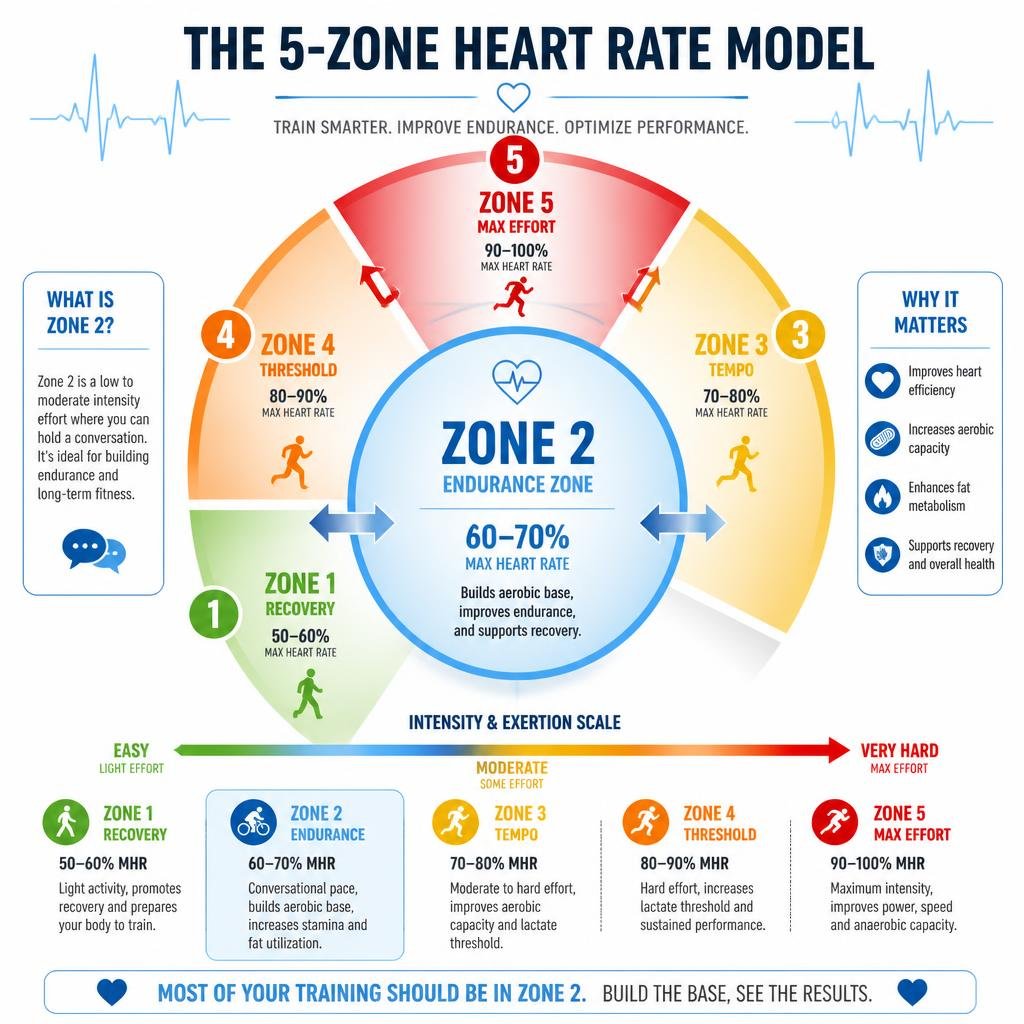
Let’s start with the basics. In the classic five-zone model, zone 2 is a low aerobic zone. It means running below your first threshold, the aerobic or ventilatory one, also called VT1. In practice, it usually sits between 70 and 80% of your maximum heart rate. That said, I want to be clear that this percentage is only a guide and changes a lot from one person to another. Don’t worry about the exact number.
In fact, the simplest and safest way to recognize it without going to a lab is the talk test. If while running you can hold a conversation in complete sentences, without running out of air, you are in zone 2. If you can only get out isolated words between gasps, bad news. You have gone too fast.
And here is the key to why it works. Below that first threshold, blood lactate levels are low. Your body recycles them without any trouble. It is an intensity you can sustain for a long time. Believe me, that is where all its magic lies.
What Happens Inside Your Body When You Run Easy
Let’s talk about the why, something almost nobody explains to you. Running in zone 2 is not “resting while running,” even if it is sometimes said with a certain contempt. It is exactly the opposite. It is an effort with a very clear physiological goal. Let me explain.
To start with, you burn fat and save glycogen. At low intensity, your body uses mainly fat as fuel. Here is a detail I find fascinating. Fat is an almost unlimited energy source. Even a lean runner stores tens of thousands of calories as fat, while they only have about 2,000 of glycogen. That is why training fat oxidation makes you more efficient and, on top of that, helps you save that precious glycogen, which is precisely the fuel that makes the difference at the end of a long race.
On top of that, and this is perhaps the most important part, you improve your mitochondria. Zone 2 stimulates what is known as mitochondrial biogenesis. Your body builds more mitochondria and makes them more efficient. Since mitochondria are the “power plants” of your cells, the conclusion is clear. The more you have, the more energy you generate without tiring and the better you perform when you really need to push. It is no coincidence that zone 2 is sometimes called “mitochondrial training.”
And there is a third benefit that I personally find the most elegant: you learn to reuse lactate. This concept is powerful, so pause here for a second. Since George Brooks’s work in the early 2000s we know that lactate is not that evil waste product we were sold for decades, but a fuel the body can reuse (the famous lactate shuttle). A well-trained metabolism produces lactate and recycles it as energy, keeping levels stable. And that, in practice, is precisely what lets you reach the end of a half marathon or a marathon in one piece, instead of falling apart.
That said, let’s be honest, because I don’t want to sell you smoke either. Although zone 2 is one of the best tools for building an aerobic base with little fatigue, there is a legitimate scientific debate about whether mitochondrial biogenesis is maximized at low intensity or whether it is also (or even more) achieved with high intensity. That is why the practical consensus is not “zone 2 only,” as some guru will try to convince you, but combining it with quality work. We’ll see that shortly.
The 4 Keys to Train in Zone 2 Efficiently
Right, that’s the theory. Now let me turn it into concrete actions. To train in zone 2 without a plan is as useless as not doing it at all.
The first key, and I will never tire of repeating it, is to genuinely run at an easy pace. The number one mistake, without a doubt, is not running slow enough. Let me give you an example. If your 10K pace is 4:30 per kilometer, your zone 2 runs should be more than a minute per kilometer slower, around 1:10 to 1:30 per kilometer slower. Yes, you read that right, that slow. Forget the ego, which is the runner’s worst enemy. That “recovery run” many do at a suspiciously race-like pace is not zone 2. It is fooling yourself.
The second key is to use the long run for the mitochondria. Here is a detail many people don’t know. The strongest mitochondrial adaptations do not arrive at minute 20 or 40. They start to appear from the one-hour mark. That is why the long run is, for me, the most important session of zone 2. As a duration guide by goal: around 1 h 10 for a 5K, 1 h 20 for a 10K, between 1 h 30 and 1 h 40 for a half marathon, and between 2 h and 2 h 30 for a marathon. That last one is a limit I would recommend not exceeding. Going beyond 2 h 30 in recreational runners rarely pays off on a risk-benefit basis.
The third key, closely tied to the previous one, is to keep an easy pace throughout the whole run. Don’t start slow only to finish running faster. And don’t start “testing yourself” in the last kilometers to see how you’re doing. The trick is to sustain that easy pace for the entire session. After one hour, holding that pace already becomes difficult. It is precisely in that controlled difficulty that the adaptations you are after happen. If you finish every long run with a negative split, even if it feels good, that undoes much of the stimulus.
And the fourth key, which many people overlook, is not to train only in zone 2. Be careful with this, because it is a very common mistake among those who discover zone 2 and become obsessed with training only in that zone. Zone 2 is the base, not the whole thing. You also need threshold work, that “comfortably hard” pace, around 15-20 s/km slower than your 10K, to learn to sustain the effort while recycling lactate. On top of that, you need some intensity, like intervals, to give training a finishing touch. The structure that works best, and the evidence backs it up, resembles the polarized model. Most of the volume should be easy, a small part should be quality, and very little should be in that intermediate “gray zone” that is neither one thing nor the other.
How It All Fits Together: Base, Threshold and a Touch of Speed
At this point, the ideal combination for a distance runner is easy to explain, even if putting it into practice is harder. First, plenty of base in zone 2, with easy runs and long runs, to improve mitochondria and efficiency. Then, well-measured threshold work, no more than once or twice a week, to learn to hold high paces while recycling lactate. Finally, some intervals as a finishing touch, but never as the main part.
There is a figure I find revealing, one you will notice in metabolically well-trained runners. They end up racing faster than they train. Why? Because their aerobic engine and threshold work so well that, in a race, they recycle lactate instead of falling apart. So it is clear. There is no need to repeat race pace in every workout. As the saying goes, and it is true, you train by training and you race by racing.
To find out your zone 2 and threshold paces from a recent race, I suggest using our training pace calculator. If you want to understand better how the zones and quality days are organized, you can read the guide on how to calculate your training paces.
One last note I don’t want you to miss. Running easy most of the time also reduces injury risk. We already saw this in the runner injury prevention guide. If you want external backing, the research on polarized intensity distribution, the famous 80/20, is well documented in the scientific literature.
Conclusion
In short, training in zone 2 done well comes down to four points that, if I’m honest, completely change the outcome. Run genuinely easy, more than a minute per kilometer slower than your 10K. Use the long run of over an hour for the mitochondrial stimulus. Keep the easy pace from start to finish, with no negative splits. Don’t train only in zone 2, add threshold and some intervals.
My final advice, after all this, is to stop worrying so much about pace and start thinking about adaptations. When it’s time to go easy, do it for real. When it’s time to push, do it without fear. When you train in zone 2 the right way, that balance, strange as it may seem, is exactly what helps you run faster by running slower. Choose well, run better.
Frequently Asked Questions
What is zone 2 in running and how do I train in it?
It is a low aerobic zone. It is below your first threshold, the aerobic one, and sits around 70-80% of maximum heart rate. In this zone, lactate stays low and you can hold the effort for a long time. The clearest and most reliable sign is that you can talk in complete sentences while running.
At what pace should I run in zone 2?
Much slower than most people think. As a reference, between 1:10 and 1:30 per kilometer slower than your 10K pace. If you are only a few seconds slower than race pace, I’m sorry, but you are not in zone 2. The best way to set it is to use a recent race together with a pace calculator.
How long should the long run in zone 2 be?
It depends on the goal. Around 1 h 10 for 5K, 1 h 20 for 10K, between 1 h 30 and 1 h 40 for a half marathon, and between 2 h and 2 h 30 for a marathon. Since the strongest mitochondrial adaptations appear from the one-hour mark, duration matters a lot.
Can I improve by training only in zone 2?
Honestly, it is not ideal. Zone 2 builds the aerobic base, but you also need threshold work and some intervals to perform in competition. If you only train easy, you will lack intensity adaptations. If you only train hard, you can’t build base. As with almost everything in life, the key is balance.
Is it true that lactate is not harmful?
That’s right. Since George Brooks’s work we know that lactate is not just a waste product. It is a fuel the body can use again as energy. A well-trained metabolism produces and recycles lactate and keeps it stable. This lets you sustain high paces for longer.