Golden Trail World Series 2026: Elazzaoui Wins a Third Title by Two Points as Florea Repeats
The 2026 Golden Trail World Series ended this weekend in Muju, South Korea, with two champions who defended their titles. Morocco’s Elhousine Elazzaoui won the men’s Grand Finale and took his third overall title in a row, something no one had done before in the series. Romania’s Madalina Florea finished second in the women’s final, won by Iceland’s Andrea Kolbeinsdóttir, and kept her overall crown. Spain’s Alain Santamaría was fifth and fastest on the steepest downhill of the race.
Elazzaoui wins the final and his third Golden Trail title
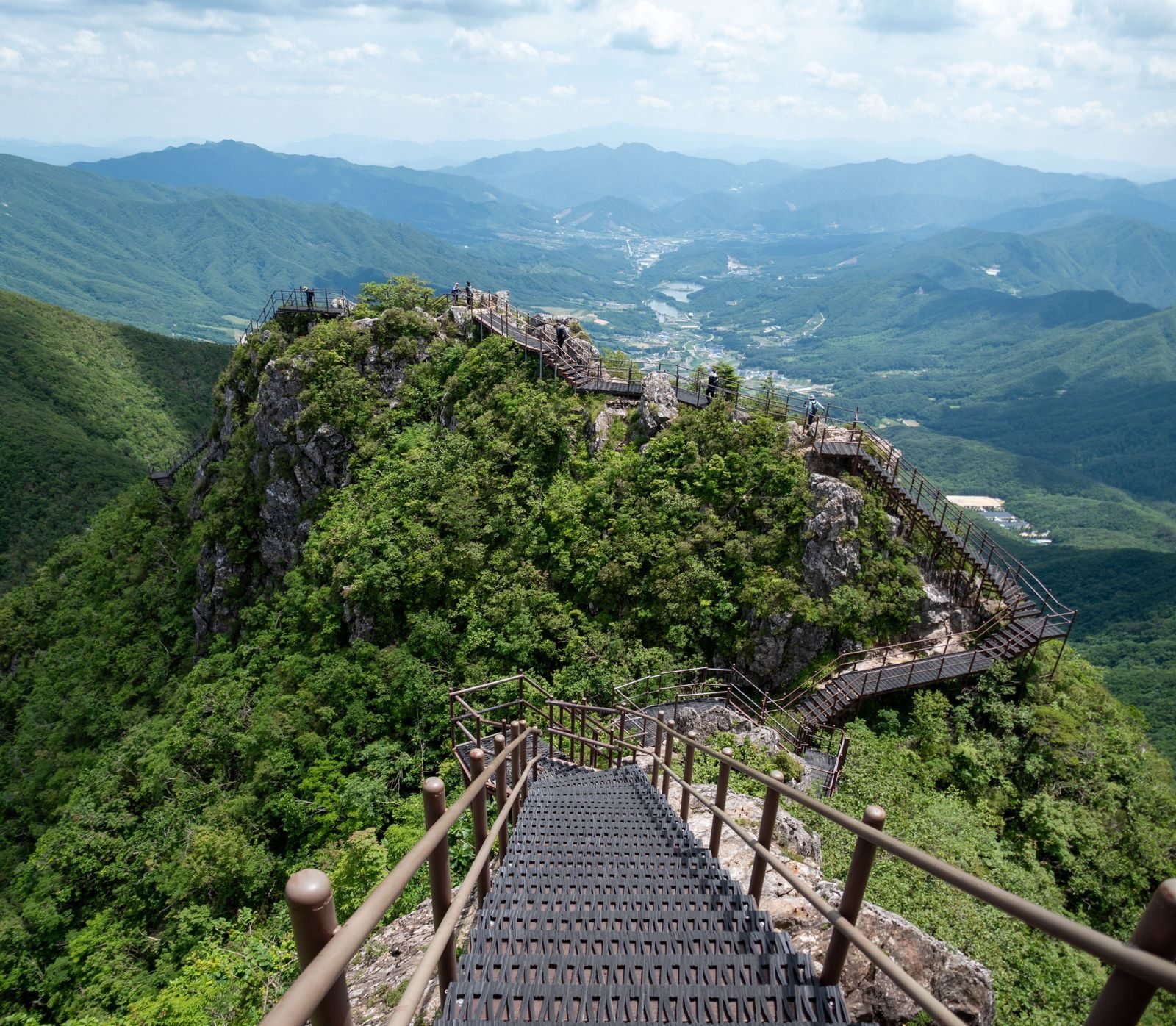
The men’s Grand Finale was held on Sunday 25 October in the rain, in Deogyusan National Park, over 28.65 km with 2,313 metres of climbing. Three contenders arrived 46 points apart: Kenya’s Philemon Kiriago, the leader, his teammate Patrick Kipngeno and Elazzaoui in third. The Moroccan knew only a win would do.
Kiriago tried an early move on the first climb, but the group soon came back together. Elazzaoui attacked on the ridge between Seolcheonbong and Hyangjeokbong, the highest point of the course at around 1,600 metres, and was a minute clear by 6.5 km. On the technical descent to Baengnyeonsa Temple, all steps, rocks and wet leaves, he stretched the gap. By the second time over Hyangjeokbong he led his chasers by more than five minutes and Kiriago, down in 15th, by more than twelve.
Elazzaoui won in 2:49:14. Kipngeno came through on the last climb to finish second, 43 seconds back, and Timothy Kibett was third at a minute and a half. It was the Moroccan’s fourth win of the season after Zegama-Aizkorri, Ledro Sky Trentino and the Salomon Pitz Alpine Glacier Trail. According to the organisers, this title makes him the most successful athlete in Golden Trail World Series history. He said at the finish that he had written “To be or not to be” on his hands to remind himself it was all or nothing.
How the Golden Trail title came down to two points
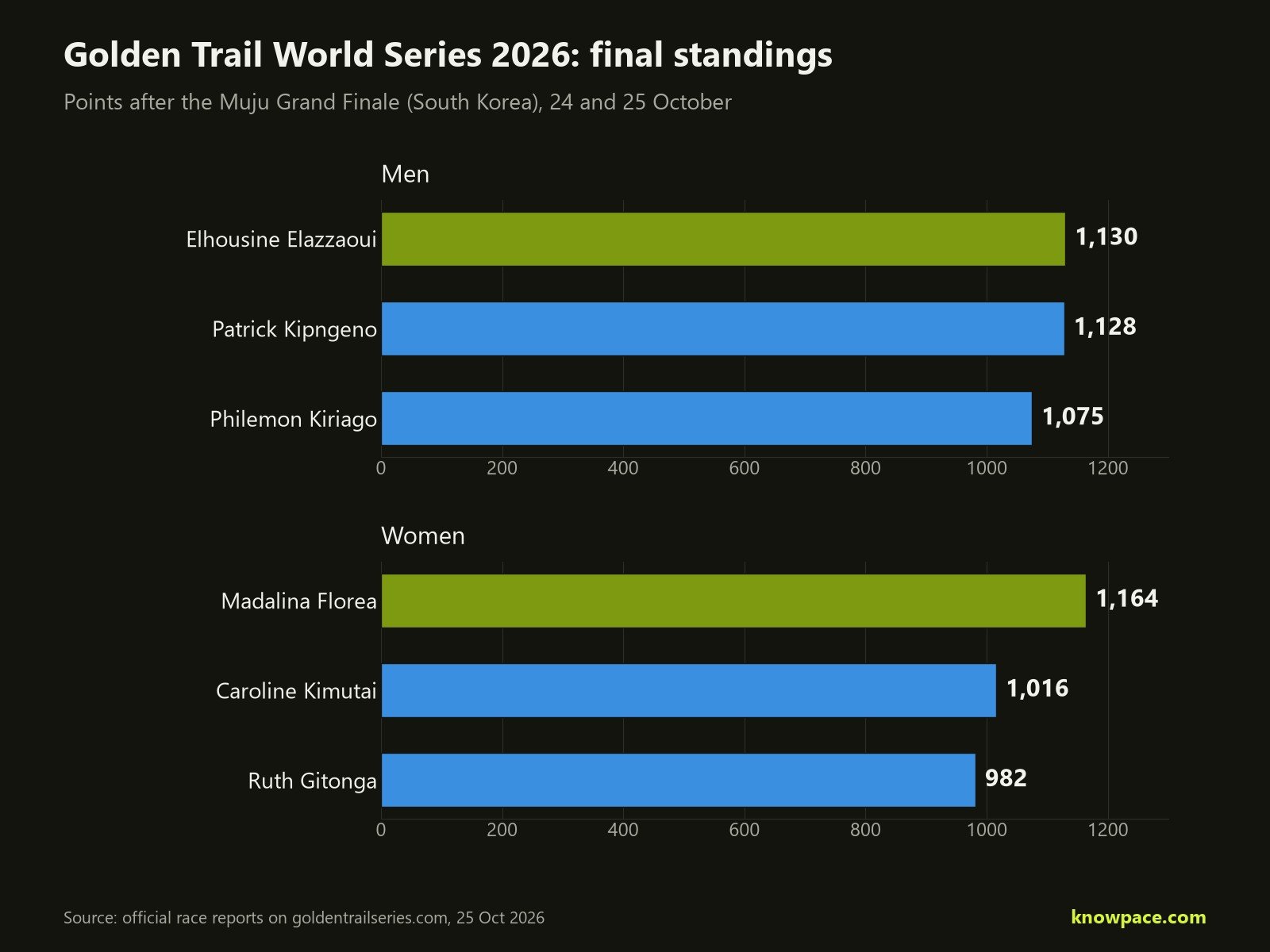
The final standings read Elazzaoui 1,130 points, Kipngeno 1,128 and Kiriago 1,075. The Grand Finale paid 300 points to the winner instead of the usual 200, and the timed segments counted too: an uphill, a downhill and a sprint where the fastest runners earn bonus points.
Those segments had worked against Elazzaoui all year. Kiriago arrived in Korea with 106 bonus points to the Moroccan’s 58, and without them Elazzaoui would have started the final as leader. In Muju he picked up just two segment points, for fifth fastest on the 2.5 km downhill at 28 percent, which turned out to be his exact winning margin over Kipngeno. Kiriago lost four minutes by 9 km and finished 11th, dropping to third overall.
Alain Santamaría, fifth and fastest downhill
The best Spanish runner was Alain Santamaría (X-Bionic Integrity), fifth in 2:54:00. He ran in the chase group for most of the race and was fastest on the downhill segment to Baengnyeonsa, covering the 2.5 km at 28 percent in 11:54. On the second descent to the temple he again opened a gap on Taylor Stack and Joey Hadorn, but in the closing stages Kipngeno and Kibett passed him, and Hadorn finished fourth ahead of him.
In the women’s race, Estel Roig Fortin (Scott) finished 13th in 3:43:45 and Naiara Irigoyen (X-Bionic Integrity) 14th in 3:47:35, according to the official Golden Trail World Series results.
Kolbeinsdóttir wins in Muju, Florea keeps the Golden Trail crown
The women raced on Saturday 24 October over the same terrain. Caroline Kimutai (Salomon) opened a gap on the first climb, Florea caught her on the descent, and Kolbeinsdóttir worked her way up to pass the Romanian near the top of Hyangjeokbong. The two swapped the lead until the final climb to Chilbong: 2.2 km at an average 25.2 percent, with sections over 40 percent where runners had to use their hands. There Kolbeinsdóttir went clear and won in 3:19:56, almost six minutes ahead of Florea (3:25:46). Mexico’s Miriam Morales was third in 3:29:12.
Florea ends the season on 1,164 points, ahead of Kimutai (1,016) and Ruth Gitonga (982), for her second straight title. This year she also won the Québec Mega Trail, the Pitz Alpine Glacier Trail and Sierre-Zinal. At the finish she called Muju the hardest race she had ever run.
Kolbeinsdóttir reached the final with a Golden Ticket, the direct entry won at the Golden Trail National Championships; she earned hers in Australia. Nineteen athletes qualified that way through eight races on three continents.
What recreational runners can take from the Golden Trail final
The Muju final was decided on the technical descents as much as on the climbs: Elazzaoui built his lead going down to the temple, and Santamaría won that segment. Descending fast and safely is a skill you can train, and our guide to downhill running covers technique and how to add descents to your plan, while hill training covers the climbs.
Mountain running also tires you differently from road running; we looked at the data in marathon and trail fatigue, a study that compared muscle fatigue in the two. If you are thinking of moving to the trails, start with our first trail race guide and choose shoes with grip in the wet: trail running shoes explains what to look for.
The organisers will soon announce the 2027 Golden Trail calendar, the series’ tenth anniversary year, and Elazzaoui has already said he wants to come back. The top three men and women in Muju who arrived from outside the overall top 30 earn a place in the 2027 series.
All figures come from the official race reports for the men’s final and the women’s final, and the official Muju Trail results.
Frequently asked questions
Who won the 2026 Golden Trail World Series?
Elhousine Elazzaoui in the men’s standings, with 1,130 points, and Madalina Florea in the women’s, with 1,164. It is his third straight title and her second.
Who won the Golden Trail final in Muju?
Elazzaoui in the men’s race, in 2:49:14, and Andrea Kolbeinsdóttir in the women’s race, in 3:19:56.
How did the Spanish runners do?
Alain Santamaría was fifth among the men in 2:54:00. Estel Roig Fortin finished 13th and Naiara Irigoyen 14th among the women.
How does Golden Trail scoring work?
Each race pays 200 points to the winner and the final pays 300. The fastest runners on the uphill, downhill and sprint segments also earn bonus points.
Choose well, run better.