Marathon and Trail: A Study of 41 Runners Measures Which Race Leaves More Muscle Fatigue
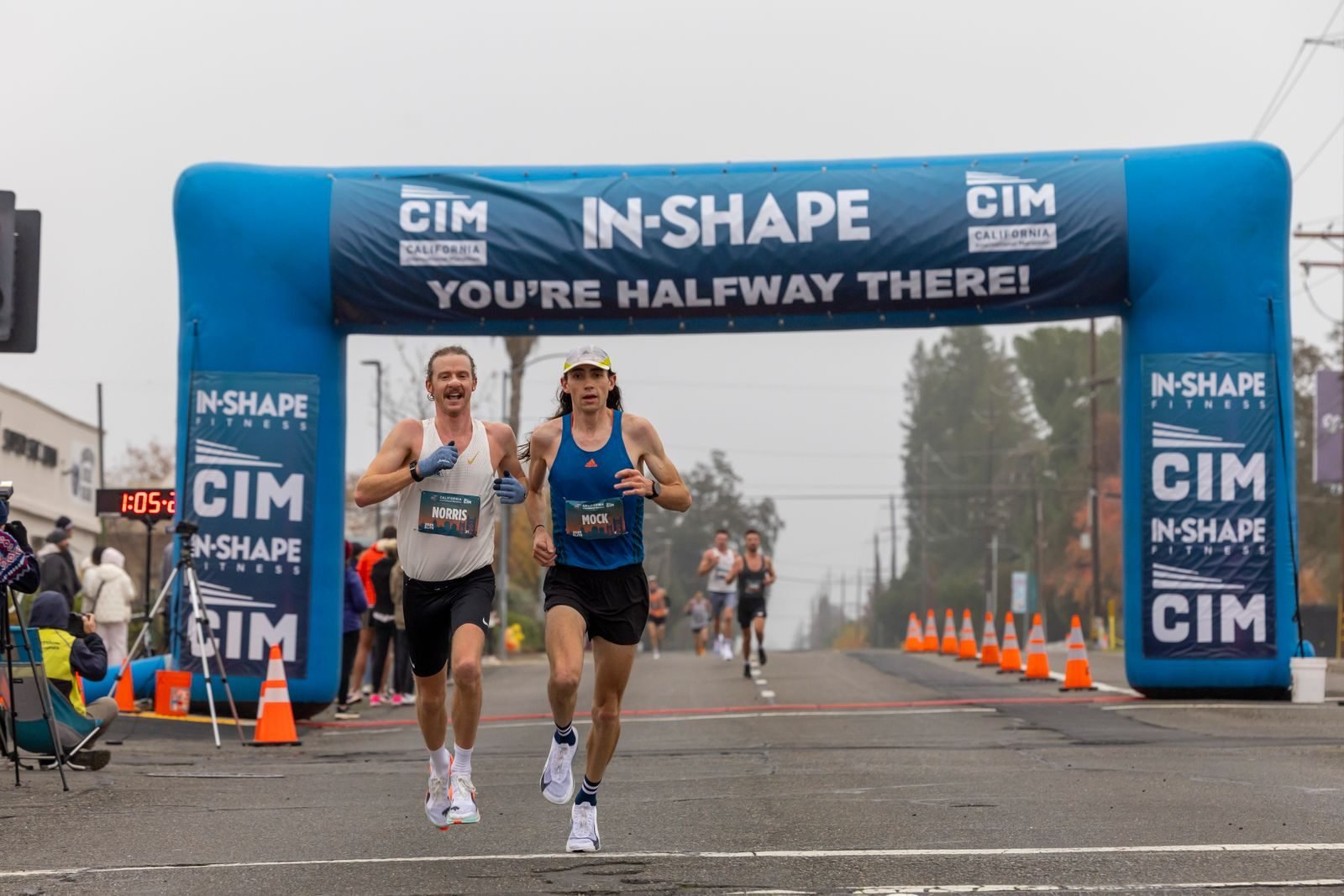
A French study of 41 trained runners has compared the fatigue left by marathon and trail races of equivalent effort, and the marathon comes out worse: a bigger drop in quadriceps activation, more muscle damage in the blood, a weaker jump and soreness that lasts longer. The authors are from Jean Monnet University in Saint-Étienne, including Guillaume Millet, and Loughborough University, and the paper was published on 23 October in Medicine & Science in Sports & Exercise, the journal of the American College of Sports Medicine.
How fatigue in marathon and trail was compared
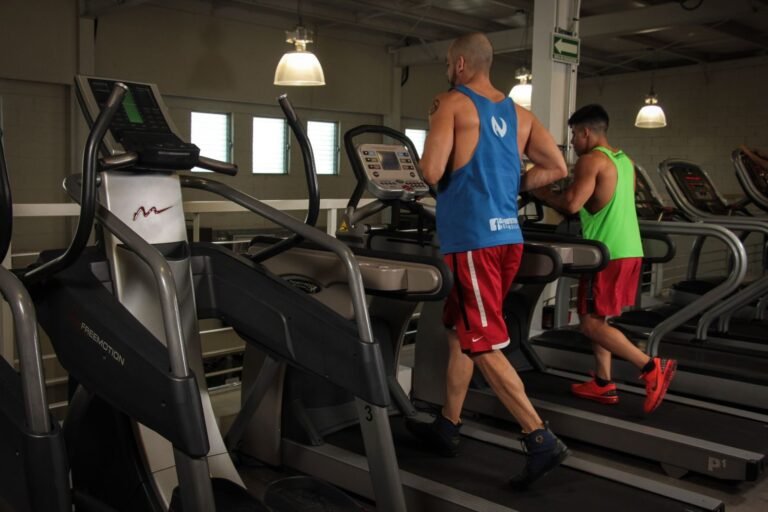
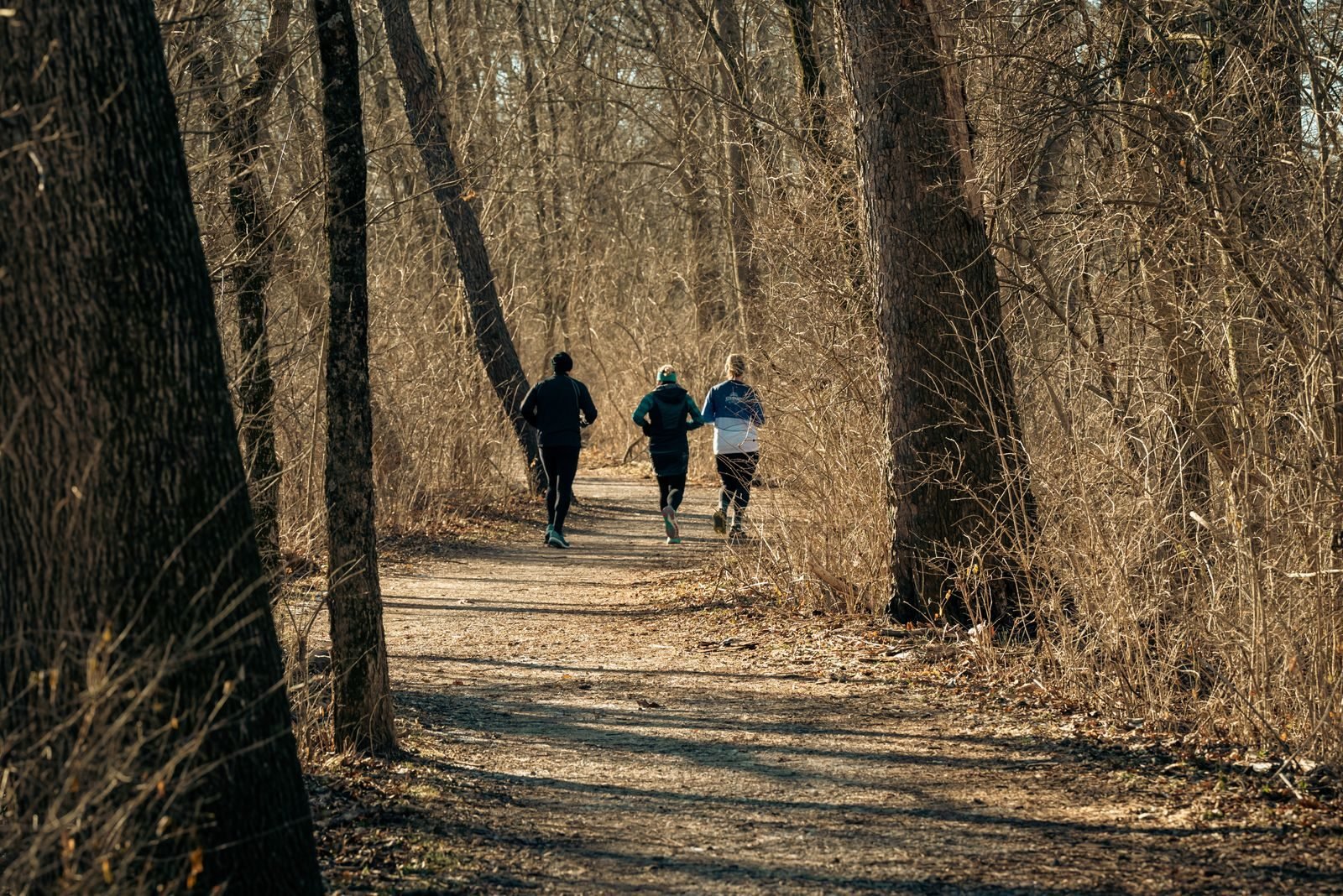
Each runner did the event of their own specialty. Road specialists ran a simulated marathon on a treadmill. Trail specialists did one of two trail versions: a simulated run on a treadmill or a real run in the mountains. Both trail runs were 29 km with 1,400 m of climbing and the same of descent, a distance chosen so the effort would match the 42.195 km.
The researchers measured neuromuscular fatigue before the run, right after it, and one, two and seven days later, in the quadriceps and the calves. For each muscle group they recorded maximal voluntary force, voluntary activation (how much muscle the nervous system manages to recruit) and the response to electrical stimulation, which reflects fatigue inside the fibre itself. They also tracked blood markers of muscle damage, jump height and the force velocity profile, and ran muscle soreness questionnaires over the following month.
Results: the marathon hits the quadriceps harder
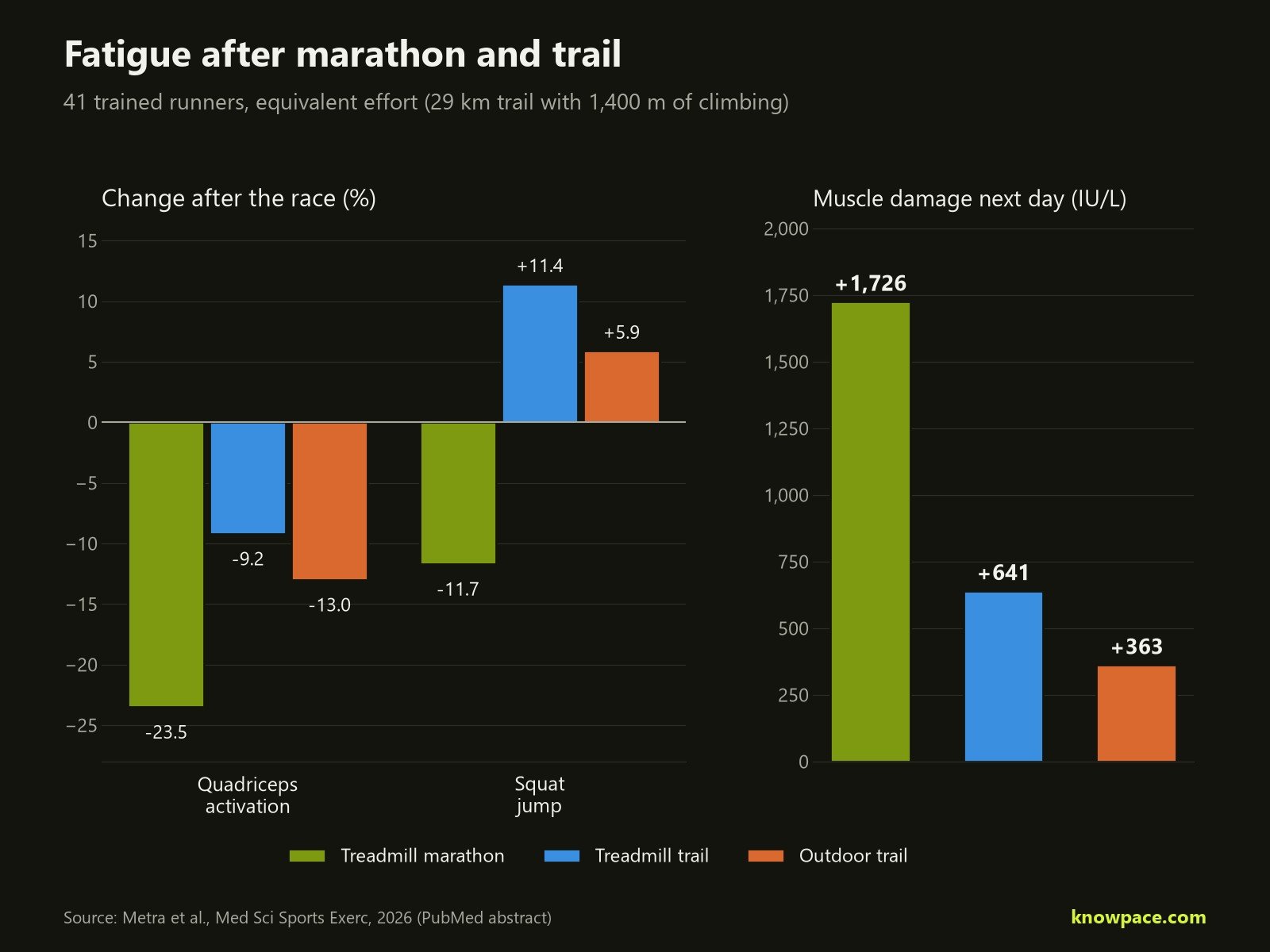
| Measure | Treadmill marathon | Treadmill trail | Outdoor trail |
|---|---|---|---|
| Quadriceps voluntary activation | -23.5% | -9.2% | -13.0% |
| Squat jump | -11.7% | +11.4% | +5.9% |
| Muscle damage markers the next day | +1,726 IU/L | +641 IU/L | +363 IU/L |
On those three measures the differences between marathon and trail were significant, against both the treadmill and the outdoor version. Quadriceps activation and jump height also took longer to return to baseline after the marathon, and the trail runners stopped feeling sore sooner.
Other measures showed no difference between groups: maximal quadriceps force, its response to electrical stimulation, all the calf variables and the force velocity profile. The authors conclude that the marathon causes greater acute neuromuscular changes than trail running, mainly in the quadriceps, with a slower return to baseline.
What the drop in voluntary activation means
Voluntary activation fell much more after the marathon, while the quadriceps response to electrical stimulation did not differ between groups. That indicates the extra fatigue from the marathon was mainly nervous in origin: the brain and spinal cord were recruiting the muscle less well. That is the pattern seen in the quadriceps when comparing marathon and trail in this study.
The comparison between marathon and trail may come as a surprise, since trail races have long descents and running downhill is very demanding on the quadriceps, as we explain in downhill running. Even so, the 29 km mountain runs left a smaller measurable mark. The abstract does not analyse why.
What this lab had already measured in the mountains
Guillaume Millet has been measuring fatigue in mountain runners for years, and two earlier papers help to read this comparison of marathon and trail. In 2013, in a study led by the University of Lausanne, his team tested 15 runners before and after a 330 km mountain race with 24,000 m of climbing and descent, which they finished in 122 hours on average. Maximal quadriceps force fell by 24% and calf force by 26%. The authors found less fatigue, damage and inflammation than in shorter mountain ultras, and put it down to runners holding back in the first half and to sleep deprivation in the second.
In 2021, by then in Saint-Étienne, they compared 18 pairs of men and women of the same level after races of 40 to 171 km. Quadriceps strength fell by 36% in men and 27% in women, whatever the distance.
The 2013 paper points the same way as the new marathon and trail study: in the mountains, more distance and more climbing do not simply add up to more fatigue, and those authors linked it to pacing. The 2021 paper leaves an open question, because the new study’s abstract does not say how many women ran in each group.
What it changes for your marathon and trail recovery
If you mix marathon and trail in the same season, these data suggest leaving more room after a road race than after a mountain race of similar effort. After the marathon, quadriceps activation and jump height took longer to recover and soreness lasted longer, so it is worth not returning to hard sessions just because the soreness has gone. The phases and timings are in our guide to marathon recovery.
If you are moving from road to mountains, the first trail race guide helps you choose distance and climbing. On how performance holds up during long mountain efforts, we also covered a Spanish study on durability in trail runners.
Limitations
The comparison between marathon and trail was not crossover. Each runner did a single event, the one of their specialty, so the marathon group was made up of road runners and the trail groups of mountain runners. Part of the difference could come from how each profile is adapted and not only from the type of race.
The marathon was run on a treadmill, without the wind, turns or atmosphere of a real race, and there was no real road marathon to compare against. The abstract does not give the number of runners in each marathon and trail group, how many were women, or the paces. The full text is paywalled, so only the official abstract could be reviewed here, on PubMed and on the journal website. The two earlier papers are the 2013 study of a 330 km race and the 2021 study on sex differences.
Frequently asked questions
Is a marathon or a trail race more tiring?
In this marathon and trail study, a treadmill marathon caused more quadriceps fatigue, more muscle damage and longer soreness than two 29 km trail runs with 1,400 m of climbing designed as an equivalent effort.
Why does the marathon tire the quadriceps so much?
The study does not give the cause. What it shows is that the drop was mainly in voluntary activation, which is nervous in origin, while the muscle’s own response to electrical stimulation did not differ between groups.
What is voluntary activation?
It is the share of a muscle that the nervous system manages to recruit in a maximal effort. When it drops, fatigue has a nervous component as well as a muscular one.