ASICS METASPEED EDGE TOKYO
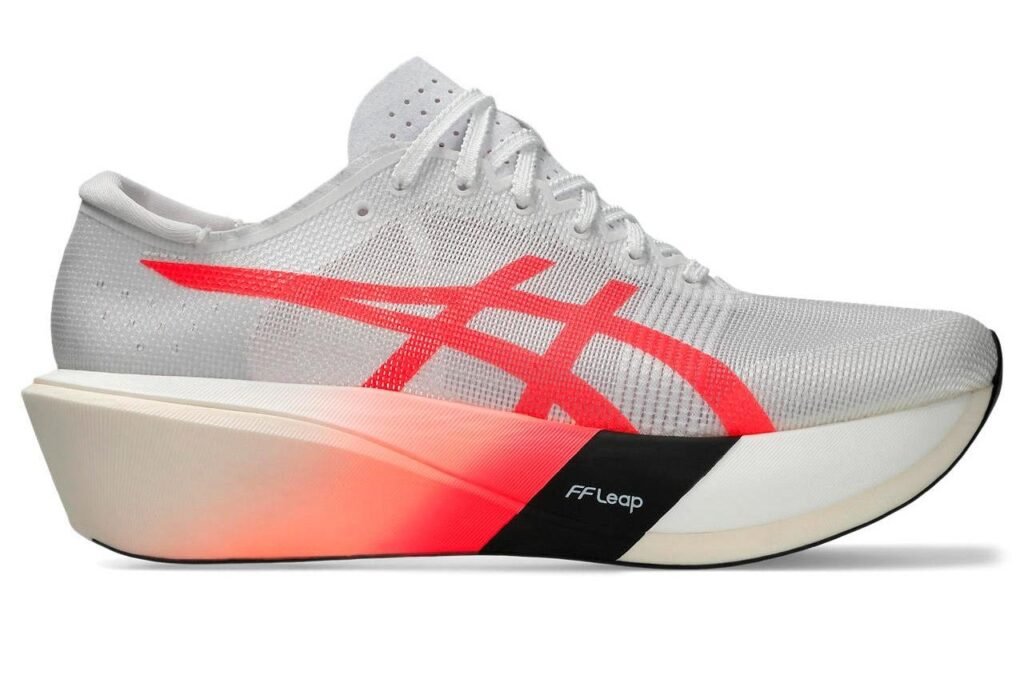
| Type | Road |
| Weight | 159 g |
| Drop | 7 mm |
| Foot strike | Neutral |
| Recommended use | Racing |
| Carbon plate | Yes |
ASICS Metaspeed Edge Tokyo Review: Features, Specs and Verdict
The ASICS Metaspeed Edge Tokyo is ASICS’s racing shoe for runners who speed up by raising their cadence, with FF Leap foam, a curved carbon plate and a lab weight of 159 grams. BIKILA sells it as the Metaspeed Edge 4 Tokyo (code 1013A163), at €270 in the colour with the most sizes.
This review combines the official description published by BIKILA with the lab tests from RunRepeat. We have not tested it, and the score on this page, 9.2 out of 10, is RunRepeat’s rating.
What the ASICS Metaspeed Edge Tokyo is
BIKILA describes the ASICS Metaspeed Edge Tokyo as a marathon and half marathon shoe for runners who increase their stride frequency to go faster. RunRepeat finds it useful from the 5K to the marathon. Its sibling, the Metaspeed Sky Tokyo, is aimed almost exclusively at midfoot and forefoot strikers, according to RunRepeat.
ASICS Metaspeed Edge Tokyo specs
| Feature | Lab measurement (RunRepeat) |
|---|---|
| Weight | 159 g |
| Heel stack | 38.9 mm |
| Forefoot stack | 32.0 mm |
| Drop | 6.9 mm |
| Energy return (heel / forefoot) | 78.3% / 76.8% |
| Foam hardness | 24.5 (average: 35.4) |
| Stiffness at 30 degrees | 15.8 N (average: 15.5 N) |
| Price | $270 in the US; €270 at BIKILA (November 2026) |

FF Leap foam
This is the main change in this version. FF Leap is made of A-TPU and measured 24.5 on the durometer, much softer than the FF Turbo+ in earlier Metaspeeds. It absorbed 146 impact units at the heel and 132 at the forefoot, well above average, and returned 76.8% of the energy at the forefoot, slightly less than the Sky Tokyo.
Curved plate and stability
The Edge has a curved carbon plate and the Sky a flat one. That makes the Sky 33% stiffer (21.1 N against 15.8 N) and the Edge more forgiving. RunRepeat found it more stable than the Sky, although it does not consider it a stable shoe overall.

Upper, fit and grip
The midfoot fit is narrow: the interior mould measured 89.4 mm, against an average of 95.2 mm. The toebox is a little wider than the Sky’s (73.0 mm) and tall, at 28.1 mm. It fits true to size. ASICS extended the ASICSGRIP rubber along the lateral forefoot, and wet grip scored 0.74 in the SATRA test, one of the highest results.
Durability is its weak point. The toebox scored 1 out of 5 in the Dremel wear test; the heel padding, 5.

Who is the ASICS Metaspeed Edge Tokyo for?
RunRepeat recommends it to heel strikers who find the Sky unstable, to runners who want a super shoe with a curved plate and strong grip, and to Vaporfly fans who want something lighter with more cushioning. For marathoners who want control, RunRepeat prefers the Adios Pro 4 or the Alphafly 3.
Pros and cons
Pros: weight, soft and reactive foam, grip and a wide version.
Cons: narrow fit, a fragile toebox and a price increase over the previous generation.

ASICS Metaspeed Edge Tokyo alternatives
With more control, the adidas Adizero Adios Pro 4 and the Nike Alphafly 3. Lower and built for shorter races, the Nike Vaporfly 4. All nine are compared in our guide to carbon plate running shoes.
FAQ
How much does the ASICS Metaspeed Edge Tokyo weigh?
159 grams in RunRepeat’s lab.
What is the difference between the Metaspeed Edge Tokyo and the Sky Tokyo?
The Edge has a curved plate and is more flexible; the Sky has a flat, stiffer one. RunRepeat found the Edge more stable and better suited to heel strikers.
What is the drop of the ASICS Metaspeed Edge Tokyo?
6.9 mm measured, with 38.9 mm at the heel and 32.0 mm at the forefoot.
Is BIKILA’s Metaspeed Edge 4 Tokyo the same shoe?
Yes. BIKILA’s code 1013A163 matches the Metaspeed Edge Tokyo reviewed by RunRepeat.