Nitrate and Beetroot Juice: 45 Trials Find No Gains in Trained Athletes
Beetroot juice and nitrate salts did not improve performance in trained athletes in a meta-analysis of 45 placebo-controlled trials published on 20 October in the journal Sports. The review, by researchers from Loughborough University, Shanghai University of Sport and Edith Cowan University, pools 659 athletes and finds no statistically significant effect on any of the six outcomes it analyses: peak power, mean power, VO2max, heart rate, blood lactate and perceived exertion.
Why beetroot juice is so popular
Concentrated beetroot juice is the most common way to take nitrate. As the study’s introduction explains, bacteria in the mouth convert nitrate to nitrite, which the body then turns into nitric oxide, improving mitochondrial efficiency and blood flow to the muscle. In less-trained people that has translated into small to moderate gains, mostly in long efforts.
The International Olympic Committee consensus statement on supplements (Maughan and colleagues, British Journal of Sports Medicine, 2018) lists nitrate among the few products with good evidence of benefit, alongside caffeine, creatine and some buffering agents such as bicarbonate. The same paper warns that responses vary widely between individuals and that any supplement should be tried in training first.
What the meta-analysis looked at
The authors searched for randomised, placebo-controlled trials in trained athletes, whose backgrounds ranged from recreational to elite international level. Forty-five made the cut, almost all crossover designs (41), so each participant tried both nitrate and placebo. The sample included cyclists, triathletes, runners, rowers, kayakers, cross-country skiers, swimmers and team-sport athletes.
Of the 659 participants, 556 were men and 88 were women. Only three trials studied women alone, against 36 with men only.
In 29 studies athletes took a single dose before the test, and 16 used a 3 to 8 day loading phase. Doses ranged from 4 to 19.35 mmol of nitrate per day, the most common being 6.2 to 8.4 mmol, which equals 70 to 140 ml of concentrated beetroot juice. The last dose usually came 2 to 3 hours before exercise. Most trials asked participants to avoid antibacterial mouthwash during supplementation, because it kills the bacteria involved in that first step.
Results: nitrate did not improve any outcome
None of the six outcomes improved significantly with beetroot juice or nitrate salts. The chart shows the pooled effects (Hedges g, where 0 means no effect) and their confidence intervals, and every one of them crosses zero.
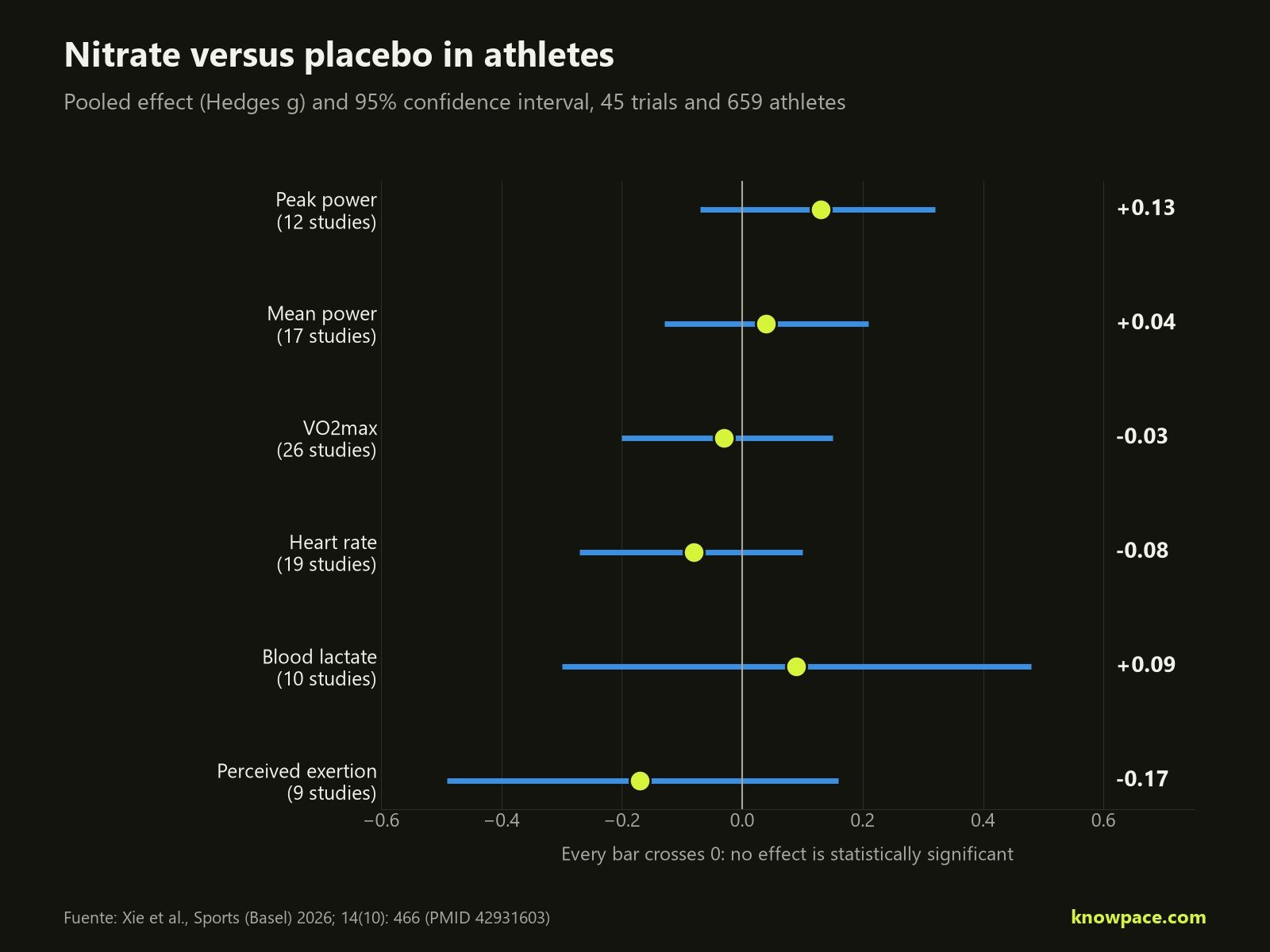
Peak power, with 12 studies, came closest (g = 0.13) without reaching significance. VO2max, the outcome with the most data (26 studies), sat at g = −0.03. Heart rate, lactate and perceived exertion did not change either.
The authors tested several subgroups. Beetroot juice and nitrate salts did not differ for VO2max, and neither did sports: in runners, the effect on VO2max was −0.04. Male-only studies did show a gain in peak power (g = 0.29), but the difference from mixed-sex studies was not significant, and after correcting for publication bias with the trim-and-fill method the effect moved towards zero. The authors ask readers to treat it as a hypothesis.
Beetroot juice had already looked weak in trained athletes
The result fits earlier work cited by the authors. A meta-analysis by Campos and colleagues (British Journal of Nutrition, 2018) found an effect size of 0.25 in non-athletes and only 0.04, not significant, in athletes. A review by Hlinský and colleagues (Nutrients, 2020) found time-trial gains only in participants with a VO2max below 55 ml/kg/min.
Elite runners show a similar picture. In the trial by Boorsma and colleagues (Medicine and Science in Sports and Exercise, 2014), eight 1500 m runners with an average VO2max of 80 ml/kg/min took beetroot juice for eight days and did not run a faster 1500 m on the track, although two of them improved.
To explain why, the study lists several hypotheses: trained athletes already produce more nitric oxide naturally, their endothelium (the inner lining of the blood vessels) works close to its ceiling, and the activity of mouth bacteria differs from person to person.

What it means for recreational runners
The meta-analysis studied trained athletes, so it does not answer whether beetroot juice helps someone who runs three days a week. Earlier work suggests there is more room for a benefit at lower fitness levels, and many recreational runners sit below that 55 ml/kg/min VO2max (you can estimate yours with the VO2 max calculator).
If you want to try beetroot juice, the most common protocol in the trials is 6 to 8 mmol of nitrate about 2 to 3 hours before, no antibacterial mouthwash on those days, and always a test run in training before using it in a race. For supplements with better evidence in athletes, see our guides to caffeine for runners and sodium bicarbonate for runners, or the recent trial of sodium bicarbonate in a 10K.
Limitations
The authors stress that the lack of significant effects does not prove there is no effect. Several confidence intervals are wide and include both zero and small to moderate effects.
The certainty of the evidence is moderate for VO2max and heart rate, low for power and very low for lactate and perceived exertion. Only one study had a low risk of bias: 33 raised some concerns and 11 were high risk, mostly because they did not describe randomisation well or were not preregistered. The meta-analysis protocol itself was registered after the first search, and two subgroup analyses were added during peer review.
Race time, the number runners care about most, was not one of the outcomes: all six are laboratory measures. Women are also barely represented (88 of 659).

Frequently asked questions
Does beetroot juice improve performance?
In trained athletes, this meta-analysis of 45 trials found no significant gains in power, VO2max, heart rate, lactate or perceived exertion. In less-trained people, a 2018 meta-analysis did find a small effect.
How much beetroot juice did the studies use?
The most common dose was 6.2 to 8.4 mmol of nitrate, or 70 to 140 ml of concentrated juice, about 2 to 3 hours before exercise.
Why avoid mouthwash when taking nitrate?
Bacteria in the mouth convert nitrate to nitrite, the step before nitric oxide. That is why most trials asked participants to avoid antibacterial mouthwash.
Is beetroot juice the same as nitrate salts?
In this meta-analysis the two did not differ for VO2max, the only outcome with enough data to compare them.
Sources: Xie et al., Sports, 2026 (PubMed), IOC consensus statement on supplements (2018), Campos et al., 2018, Hlinský et al., 2020 and Boorsma et al., 2014.