Taurine and Caffeine: 11 Trials Show Modest Gains but Cannot Isolate Taurine
Taurine taken with caffeine, the pairing found in most energy drinks, was linked to small to moderate performance gains over placebo in a meta-analysis of 11 trials published on 20 October in the journal Nutrients. The review, by researchers at Beijing Normal University, Beijing Sport University and Linyi University, pools 234 participants and finds effects on time to exhaustion and peak anaerobic power. The authors warn that the trials are few and small, and that their design cannot show how much of the effect comes from taurine.
Why taurine and caffeine are combined
Caffeine is one of the most used stimulants in sport, and its effect on endurance is well documented (see our guide to caffeine for runners). Taurine is an amino acid the body makes and also gets from food. It is involved in calcium handling inside muscle, membrane stability and the control of oxidative stress, which is why it has been proposed as a way to delay fatigue.
Most energy drinks contain both. A 250 ml can of Red Bull, for example, has 80 mg of caffeine according to the brand’s website. The marketing idea is that the two work together, but individual trials gave mixed results, some with small effects and some with none.
Which trials the meta-analysis included
The authors searched PubMed, Embase, Web of Science and the Cochrane Library up to 1 June 2026 for randomised placebo-controlled trials. Eleven qualified, ten of them crossover trials in which each person tries both the supplement and the placebo on different days.
Participants were young adults, with mean ages between 19.7 and 24, and mostly men; only two trials were women only. They included footballers, elite boxers, team-sport athletes and physical education or active students. None of the trials studied runners.
Nine trials gave both ingredients in capsules with no other active ingredients. The most common protocol was 5 mg of caffeine and 50 mg of taurine per kilo of body weight. Others used fixed doses of 80 to 200 mg of caffeine with 1,000 to 3,000 mg of taurine. One trial in American football players used a commercial energy drink with extra ingredients, and the authors analysed it separately.
Results: what improved with the combination
Time to exhaustion improved over placebo with an effect size of 0.54, but the confidence interval ran from 0.03 to 1.05 and the result comes from only three trials. Peak anaerobic power, measured in five trials, improved with an effect of 0.55 and no differences between them. Adding the commercial drink lowered the effect to 0.48.
Perceived exertion fell (−0.44) and heart rate did not change, with a mean difference of 0.11 beats per minute. Reaction time improved on average (−1.49), but variation between trials was very high (I² of 90.6%) and the prediction interval includes both gains and losses, so the authors do not treat it as a consistent effect.
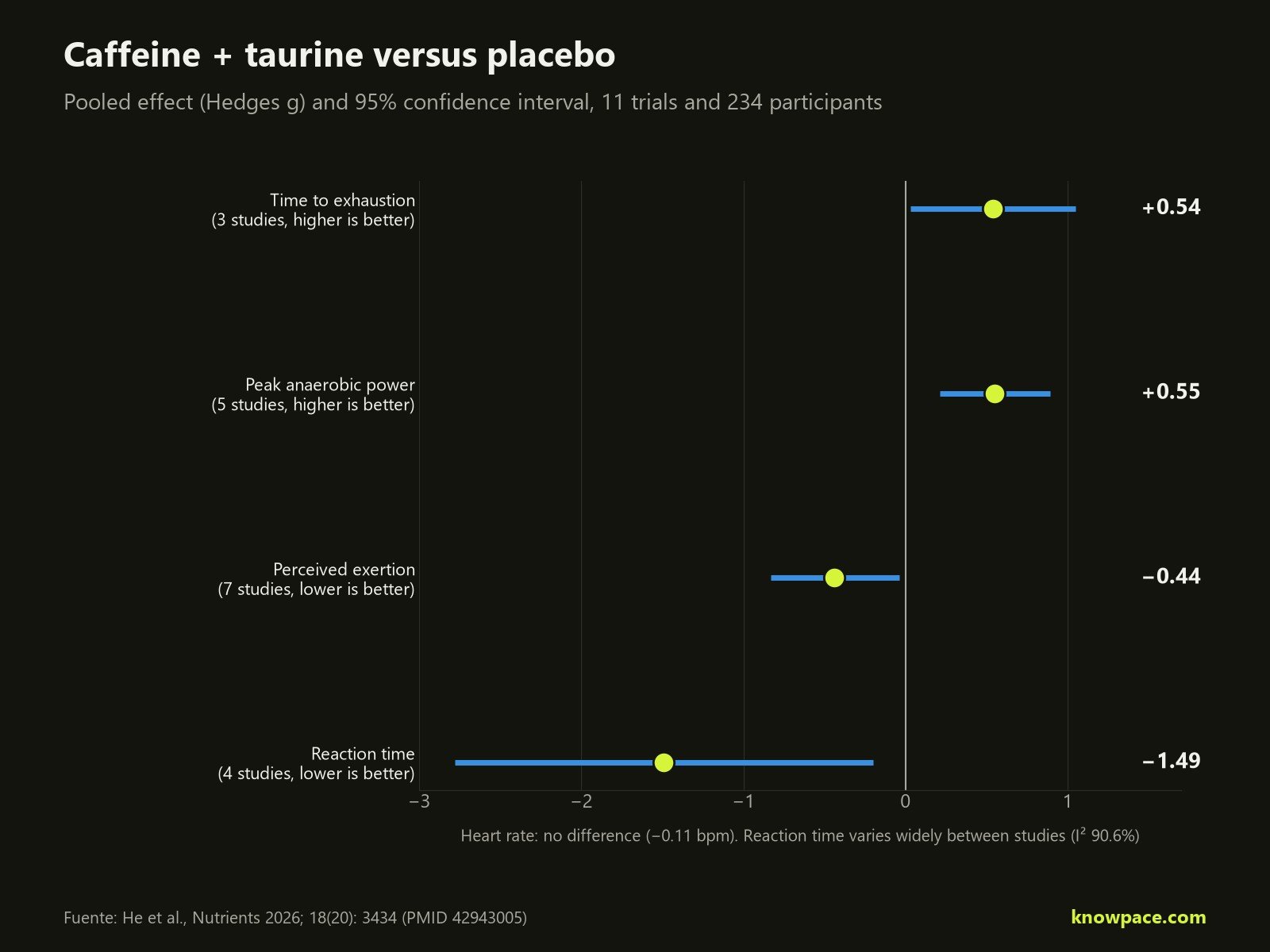
On the GRADE scale, which rates confidence in each result, certainty was moderate for heart rate and perceived exertion, low for time to exhaustion and power, and very low for reaction time.
What the study cannot say about taurine
None of the included trials compared the combination with caffeine alone. The meta-analysis measures the mix against placebo, and that design cannot tell whether taurine adds anything, whether there is synergy, or whether caffeine does all the work. The authors say so in their conclusions and call for four-arm trials: placebo, caffeine, taurine and both.
Other work looks at each ingredient. A 2018 meta-analysis by Waldron and colleagues in Sports Medicine pooled ten studies of taurine alone and found an improvement in endurance performance with an effect size of 0.40, using doses of 1 to 6 grams, with no clear link to the amount. In 2025, a network meta-analysis in the Journal of the International Society of Sports Nutrition compared all three options and ranked the combination ahead of either ingredient alone for anaerobic capacity and reaction time, while results for aerobic performance varied between studies.
The heat trial that found no effect
One of the three time-to-exhaustion trials points the other way. In the study by Aggett and colleagues (European Journal of Sport Science, 2025), ten people cycled to exhaustion at 35 °C one hour after taking 5 mg/kg of caffeine and 50 mg/kg of taurine or a placebo. Time to exhaustion did not differ. The supplement raised oxygen uptake, ventilation and heat production, and core temperature stayed the same.

What it means for recreational runners
If you already take caffeine before training or racing, the study does not settle whether adding taurine is worth it. For a 70 kg runner, the most common protocol in the trials means 350 mg of caffeine and 3.5 grams of taurine; that much caffeine equals more than four 250 ml cans of the energy drink mentioned above.
The mix did best in short power efforts and lab tests to exhaustion. For a 10K or a marathon, caffeine alone has far more trials behind it, whether from coffee, capsules or caffeinated gels. If you want to try the combination, do it in training rather than on race day, and remember that many energy drinks also carry a lot of sugar. Afternoon caffeine can also affect your night, as covered in our piece on sleep and running performance.
For other supplement pairings with recent research, see our reviews of caffeine and bicarbonate and nitrate in athletes.
Limitations of the meta-analysis
The trials are few and small: the largest had 54 footballers and the smallest seven athletes. With so few studies per outcome, publication bias could not be tested. Most crossover trials did not report the correlations needed, so the authors had to assume a value to compute the effects. One trial in professional footballers was rated at high risk of bias because it was single-blind. And nearly all participants were young men who were not runners.

Frequently asked questions
Does taurine improve running performance?
A 2018 meta-analysis found a small improvement in endurance tests with taurine alone, at 1 to 6 grams. The new review only studies the combination with caffeine and cannot separate the effect of each.
What doses did the trials use?
The most common protocol was 5 mg of caffeine and 50 mg of taurine per kilo of body weight, taken one hour before exercise in the heat trial. Other trials used fixed doses of 80 to 200 mg of caffeine.
Is an energy drink a good pre-run supplement?
A 250 ml can of Red Bull has 80 mg of caffeine, less than the doses in most trials. The meta-analysis analysed the only commercial drink separately because it contained other ingredients, so its effect cannot be credited to those two ingredients alone.
Does heart rate change with the combination?
No. The mean difference from placebo was 0.11 beats per minute, not statistically significant, with moderate certainty on the GRADE scale.
Sources: He et al., Nutrients, 2026 (PubMed), Waldron et al., Sports Medicine, 2018, Deng et al., JISSN, 2025, Aggett et al., European Journal of Sport Science, 2025 and Red Bull Energy Drink ingredients.