Ultramarathon Sleep: 9 Studies With 2,262 Runners Link More Pre-Race Sleep to Faster Finishes
In an ultramarathon, runners who slept more in the days before the start tended to finish faster, and those who slept during the race took longer to reach the finish. The finding comes from a systematic review published on 28 October in Sports Health. The work, coordinated from Bond University in Australia, pools 9 studies with 2,262 runners, mostly from mountain ultras plus one backyard-format race. All the studies are observational, so the review describes associations and does not show that more sleep makes you faster.
What the ultramarathon sleep review looked at
The authors searched PubMed, Embase, PsycINFO, SPORTDiscus and Web of Science up to 25 July 2025. They included studies of runners in events longer than 42.2 km that measured sleep and linked it to finish time or to cognitive tests such as attention and reaction time. Nine made the cut: four prospective cohorts and five cross-sectional studies.
The runners look like the field at many amateur ultras: mean age 43.7, with 74.4% men and 11.8% women (sex was not reported for the rest). Seven studies took place at mountain races, three of them at the 168 km UTMB, and distances ranged from 50 to 217 km. The designs and measures varied too much for a meta-analysis, so the results are summarised study by study.

Sleep before the ultramarathon
Four studies looked at pre-race sleep and three found a significant link with ultramarathon performance. At UTMB, Poussel’s study of 303 runners found that those who extended their sleep the night before finished faster than those who had deliberately trained on little sleep to get used to it. In a group of 9 Brazilian runners, better sleep efficiency (the share of time in bed spent asleep) went with faster finish times.
The third finding points the other way. In a 217 km mountain race, finishers took longer to fall asleep before the race than runners who dropped out: 21.8 minutes against 12.5. Both figures are under the 30 minutes considered normal, and the authors of that study suggest the finishers were more used to poor sleep and so felt the sleep loss less during the race.
In one study, mean daytime sleepiness was 9.55 on the Epworth scale, close to the cut-off of 10 for excessive sleepiness. The review suggests some ultramarathon runners arrive with sleep debt built up in training, and that extra sleep in the last few days helps them less.
Sleep during the race
Four studies linked in-race sleep to finish time, and all four tied more sleep to a later finish, except in shorter races. The largest, by Kishi and colleagues, followed 1,154 finishers of two races on Réunion Island: the Diagonale des Fous, 165 km with 9,576 m of climbing, and the 111 km Tour de Bourbon. In the first, 83% of runners slept, for about 76 minutes on average; in the second just over half did, for about 27 minutes. Of all naps, 82% lasted under 30 minutes.
Martin’s study of 636 runners split races by duration. Below 36 hours almost nobody slept and there was no link with finish time; between 36 and 60 hours, and above 60, the link was moderate. Micro-naps were the most common strategy.
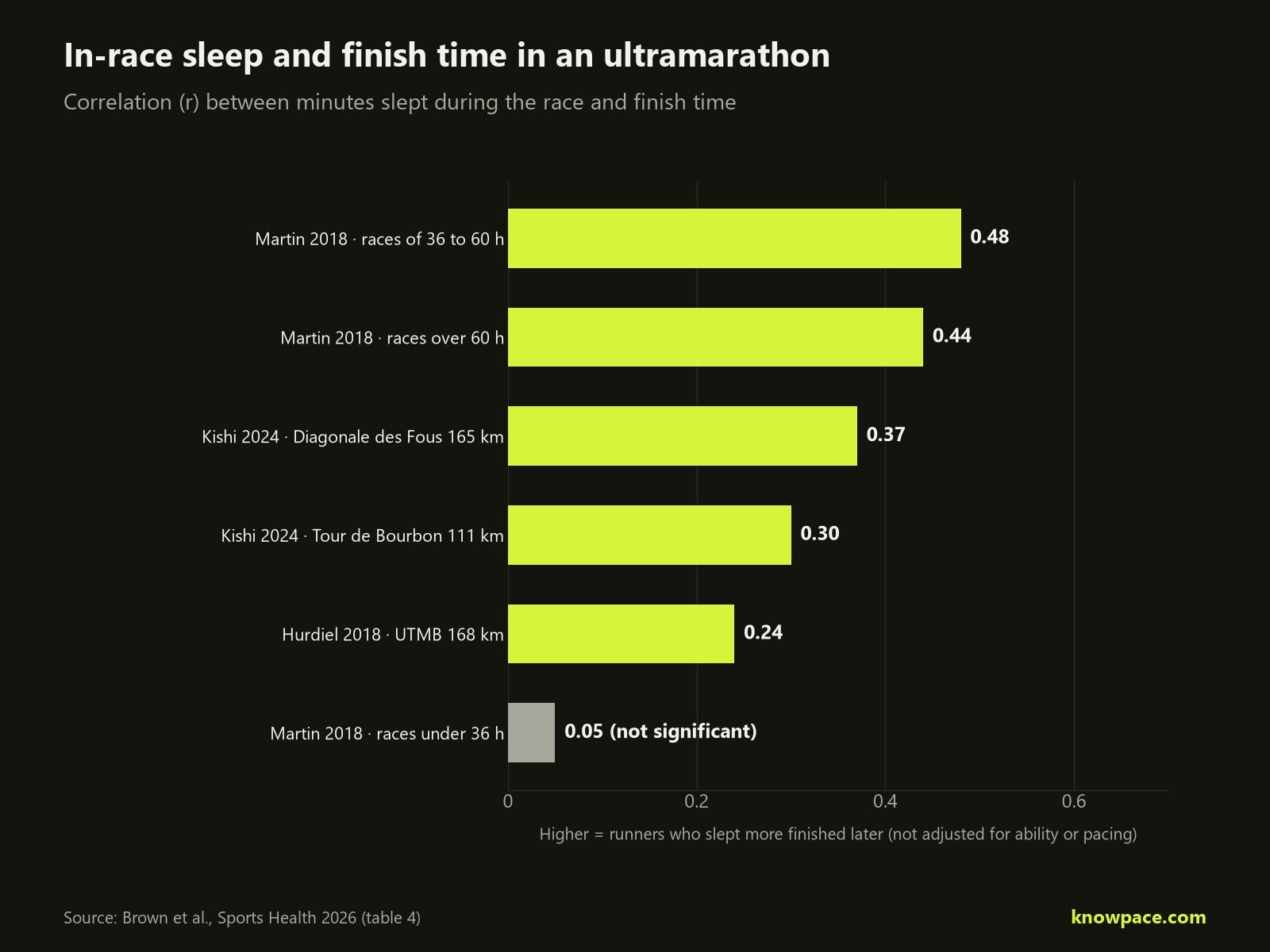
The authors ask readers to interpret this carefully. Time spent asleep is time standing still, so it adds to the clock by simple arithmetic. Slower runners also spend more hours on course and build up more sleep pressure, so they need to stop. The review does not read it as proof that sleeping in an ultramarathon is a bad idea: in multi-night races a nap may be what lets a runner finish with a clear head through the night sections.
Mental fatigue and safety
At UTMB, 47% of the runners studied by Hurdiel showed clinical signs of sleep loss: extreme sleepiness, trouble keeping their eyes open while running, brief memory lapses and loss of balance. In a later study by the same group, attention test scores fell by 0.1 correct answers for every hour on course, and sleep before each test predicted the score. Across the two Réunion races, 80% of finishers reported sleep-loss symptoms, including hallucinations and falls.
Our piece on marathon and trail fatigue showed how much quadriceps activation drops in the mountains. These data add the mental side, which matters on technical descents at night.
What to do before your next ultramarathon
The review stops short of firm guidelines because the studies do not allow them. The clearest point is to arrive rested: extending sleep in the days before was linked to faster times, and training on little sleep to adapt came out worse in the one study that compared it. Several studies found some runners rated the last night as their worst, so it pays to have the weeks before in order. The hours and habits are in our guide to sleep and running performance.
If your ultramarathon lasts more than 36 hours, plan a short nap rather than improvising one when you can barely keep your eyes open. The Réunion runners slept almost always in blocks of under half an hour. An extreme case is the Big’s Backyard Ultra world record, where the last two runners completed 124 one-hour laps, each starting on the hour.
Limitations
All the studies are observational and most are small; one had just 2 runners. Only one measured sleep with an activity monitor (actigraphy), and five used their own questionnaires, so runners may have misremembered how long they slept. No race went beyond 217 km, so longer stage races remain unstudied. The authors call for controlled studies with objective measures before making firm recommendations on extending sleep before an ultramarathon.
Frequently asked questions
How much should you sleep before an ultramarathon?
The review gives no number. Across the studies, more sleep in the days before was linked to faster times, and the general advice for adults is seven hours or more a night. The last night is often poor because of nerves, so good nights through the whole week before help.
Should you sleep during an ultramarathon?
It depends on the length. In races under 36 hours almost nobody sleeps and there was no link with finish time. In longer races, runners who slept more finished later, partly because sleep time counts on the clock, but a short nap can help you finish more alert and safely.
How long are naps in an ultramarathon?
In the two Réunion races, 82% of naps lasted under 30 minutes. In Martin’s study, micro-naps were the most common strategy.
Does training on little sleep help you adapt?
In the only study that compared it, at UTMB, runners who deliberately trained on little sleep finished later than those who extended their sleep the night before. It is an observational result, but it does not support that approach.
Source: Brown et al., Sports Health, 2026 (abstract on PubMed).