Muscle Soreness: 35 Studies Measure How Much a Previous Bout Protects You
Muscle soreness is milder when the muscle has already been through a similar effort, and a meta-analysis published today, 28 October, in Frontiers in Physiology is the first to measure how that protection changes over the following days. The review, by researchers at Beijing Sport University, Changzhou Institute of Technology and Nanjing Sport Institute, pools 35 studies. Protection against muscle soreness and strength loss peaked 72 hours after the hard session, while protection of blood markers of damage kept rising up to 96 hours.
What the repeated bout effect is
When you do an exercise you are not used to, especially one with eccentric contractions (the muscle brakes while lengthening, like the quadriceps on a descent), you get muscle damage, strength loss and soreness for several days. Repeat that effort days or weeks later and the symptoms are much smaller. Physiologists call this the repeated bout effect.
According to the study’s introduction, there are two ways to get it. One is repeating the same demanding session, with protection that different studies put at 2 to 8 weeks. The other is a light or short session beforehand, at 10 to 40% of maximal strength, between one day and two weeks earlier. In running, the classic example is downhill running, which we cover with the Byrnes study in our guide to downhill running.

What the meta-analysis looked at
The authors searched PubMed, Web of Science, Embase and Scopus up to June 2025 and registered the protocol with PROSPERO. Thirty-five studies in healthy adults qualified. The most common first session was high-intensity eccentric work; others used light eccentric work, maximal isometric contractions or, in one case, concentric contractions.
They measured three things: maximal voluntary strength, muscle soreness (on pain scales) and creatine kinase (CK), an enzyme that leaks into the blood when muscle is damaged. Results were split by hours after the hard session (24, 48, 72 and 96) and by the gap between the first and second sessions: under one week, one to two weeks, two to three weeks and more than three.
Results: how much muscle soreness drops
The previous session protected all three measures. Effect sizes were 1.18 for strength, −1.37 for muscle soreness and −0.91 for CK, all large by the usual thresholds.
By day, muscle soreness was already lower at 24 hours (−1.09), the gap grew at 48 hours (−1.51), peaked at 72 (−1.65) and eased slightly at 96 (−1.36). Strength followed the same pattern, with peak protection at 72 hours (1.47). CK behaved differently: there was no significant difference at 24 hours, and protection grew up to 96 hours (−1.53).
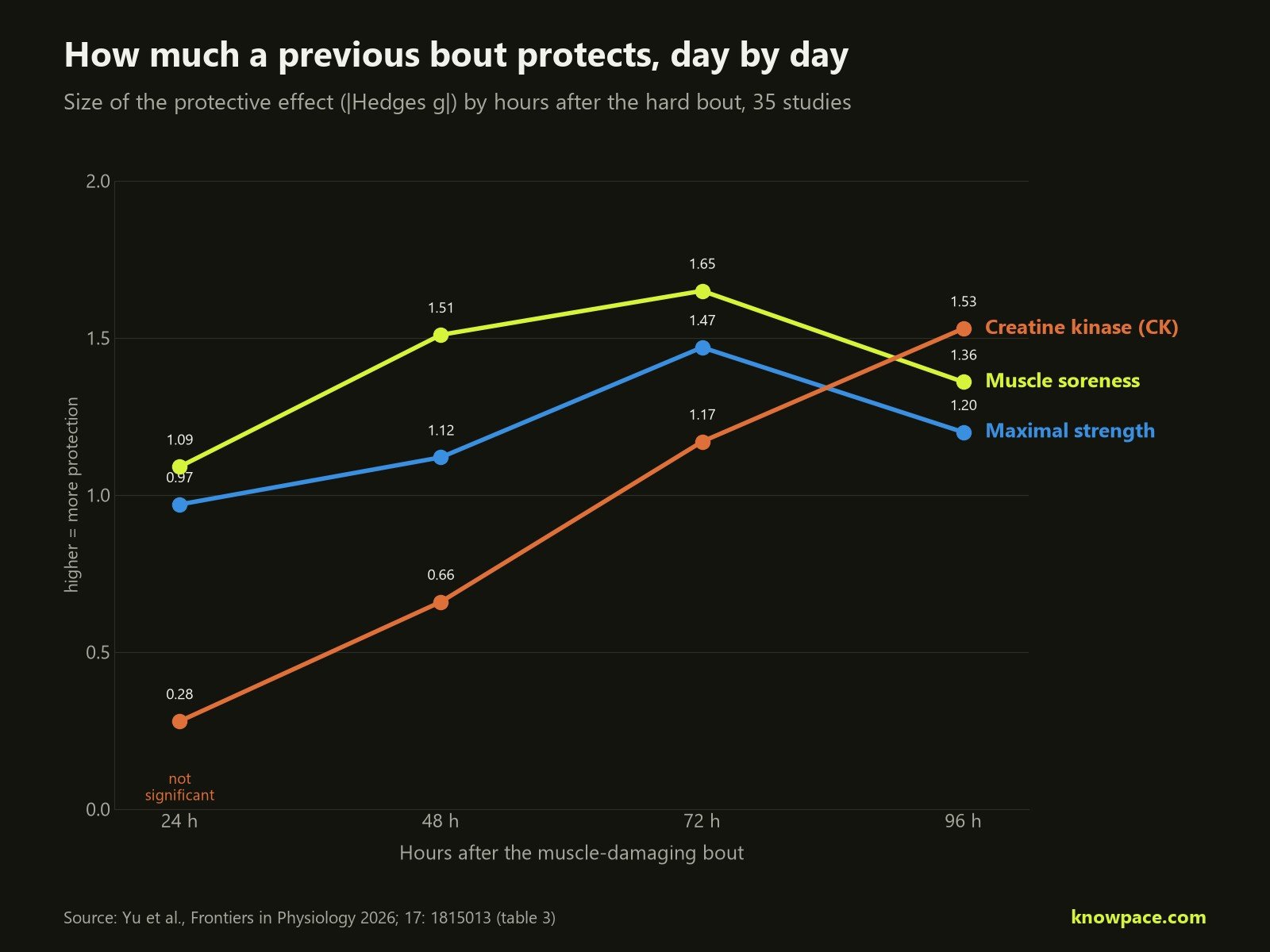
How long protection against muscle soreness lasts
With less than a week or one to two weeks between sessions, protection of strength and against soreness was significant at all four time points. With two to three weeks the effects were numerically smaller: strength only showed a significant difference at 24 hours, and soreness up to 72. With more than three weeks the effects were significant again, though based on only six or seven studies.
The authors do not draw an ideal window from this. They write that direct comparisons between gaps were not significant after correcting for multiple comparisons, and that their data do not show a period of weaker protection. An earlier meta-analysis by Boyd and colleagues (Sports Medicine, 2023), with 23 studies in people without strength training, found in its qualitative analysis that the first session worked better 2 to 4 days beforehand than right before or 1 to 3 weeks before, and protected more when it was eccentric, with more volume and intensity.
Why muscle protects itself
The study reviews three explanations from earlier work. The nervous system changes how it recruits motor units. Fibres and tendon stretch less in the second session, which lowers local strain. And the matrix around the fibres remodels. The authors link the slower CK pattern to the time the enzyme takes to leave the muscle and clear from the blood.

What it means for recreational runners
The meta-analysis rests mostly on lab exercises with a single muscle group rather than running, so it should be applied with care. It does support an idea already used in trail running: if your race has long descents, your quads should have run downhill in training first. Muscle soreness after that first session will be worse than after the next ones, and in the pooled data protection holds for at least two weeks.
For a first trail race, that means adding progressive descents in the weeks before and not trying them for the first time on race day. Hill training also helps if it includes the way down. And if your legs hurt more on day three than on day one after a marathon or mountain race, that fits the pattern the study describes; see our guide to marathon recovery and the study on quadriceps fatigue in marathon and trail fatigue.
Limitations of the meta-analysis
On the GRADE scale, certainty was low for strength and muscle soreness and very low for CK. Studies varied widely, there were signs of publication bias, and some studies compared participants with themselves instead of with a randomised control group. Full recovery before the second session was not always confirmed. Most participants were healthy young adults in controlled tests, and the authors note this limits how far the results apply to multi-joint training or competitive athletes.

Frequently asked questions
Why do I get less muscle soreness the second time I do a workout?
Because of the repeated bout effect: after a new effort, muscle and the nervous system adapt and the same effort causes less damage. In the meta-analysis, a previous session reduced soreness with an effect size of −1.37.
When is protection against muscle soreness strongest?
At 72 hours after the hard session. That is where the soreness gap in favour of people who had done the earlier session was largest of the four time points, and it was slightly smaller at 96 hours.
How long does protection against muscle soreness last?
It was significant with one or two weeks between sessions. Other work cited in the study puts it at 2 to 8 weeks when the same demanding session is repeated.
Can a light session prevent muscle soreness?
Several studies use a low-intensity first session, at 10 to 40% of maximal strength, between one day and two weeks earlier, and it also reduces later damage, although protection varies with the muscle and type of contraction.
Sources: Yu et al., Frontiers in Physiology, 2026 and Boyd et al., Sports Medicine, 2023.